
THE THREE AMINO ACIDS AND THE BH4 CONNECTION
THE THREE AMINO ACIDS AND THE BH4 CONNECTION
THE THREE AMINO ACIDS AND THE BH4 CONNECTION
Phenylalanine. Tyrosine. Tryptophan.
How three fundamental building blocks connect neurotransmission, immunity, vascular function, microbial signalling and cellular metabolism
An accompanying deep dive to: The Biochemistry of Interconnected Constraint
There is a point in following a biochemical pathway when the subject stops being one pathway.
You begin with an amino acid. You follow the enzymes that transform it, the cofactors that make those reactions possible, and the products that emerge. Then you discover that those products are not endpoints. They become the starting materials for another system, another signalling pathway, another biological function.
Follow three amino acids far enough and you encounter an extraordinary amount of human biology.
Phenylalanine. Tyrosine. Tryptophan.
They are often introduced as components of dietary protein. But their importance extends far beyond protein construction. They sit at the entrances to pathways involved in neurotransmitter production, hormonal signalling, immune regulation, vascular function, sleep, cellular metabolism and communication between the microbiome and its host.
And then there is BH4.
Tetrahydrobiopterin is not a household name. Most people will never have encountered it in a discussion of nutrition, gut health or general metabolism. Yet this small molecule is required by several enzymes that connect some of the very systems we have been investigating.
It was this shared dependency that made us stop and look more closely.
The individual pathways are well established. What becomes interesting is seeing them together.
1. Three amino acids, several biological destinations
The three amino acids belong to the aromatic amino-acid family. Their chemical structures and metabolic relationships place them at important junctions in human biochemistry.
Two are essential dietary amino acids: phenylalanine and tryptophan. Tyrosine can be obtained from food and can also be synthesised from phenylalanine.
Their pathways are interconnected, but their destinations are remarkably diverse.
Phenylalanine: the starting point for tyrosine production
Phenylalanine is an essential amino acid. The body cannot synthesise it in sufficient quantities and must obtain it from dietary protein.
One of its important metabolic destinations is tyrosine.
The enzyme phenylalanine hydroxylase (PAH) converts phenylalanine into tyrosine. This reaction requires:
- Tetrahydrobiopterin (BH4)
- Ferrous iron (Fe²⁺)
- Molecular oxygen
This is the first important connection.
The production of tyrosine is not simply a matter of having enough phenylalanine available. It also depends on the enzyme and its supporting biochemical environment.
Tyrosine then becomes available for several major biological functions.
Tyrosine: far more than a protein building block
Tyrosine is incorporated into proteins, but it also supplies several specialised metabolic pathways.
It is involved in:
- Catecholamine neurotransmitter synthesis.
- Thyroid hormone production.
- Melanin synthesis.
- Protein construction and cellular signalling.
Its best-known neurological route begins with tyrosine hydroxylase (TH).
TH converts tyrosine into L-DOPA. This reaction also requires BH4, ferrous iron and oxygen.
L-DOPA is then converted into dopamine by aromatic L-amino-acid decarboxylase (AADC), which requires vitamin B6 in its active pyridoxal phosphate form.
Dopamine can subsequently be converted into noradrenaline, and noradrenaline into adrenaline.
The sequence is:
Tyrosine → L-DOPA → Dopamine → Noradrenaline → Adrenaline
These compounds participate in movement, motivation, attention, reward, stress responses, autonomic regulation and cardiovascular function.
The importance of this pathway is not confined to the brain. Catecholamines also function in peripheral tissues and participate in the body’s wider physiological response systems.
Tyrosine also enters thyroid hormone synthesis. Thyroid hormones are built from iodinated tyrosine residues within thyroglobulin, making tyrosine chemistry part of the machinery governing metabolic rate, growth and development.
One amino acid therefore supplies several distinct biological systems.
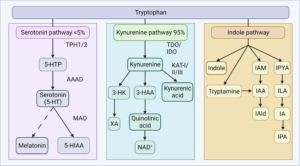
Tryptophan: the meeting point of three major pathways
Tryptophan is another essential dietary amino acid.
Its importance becomes particularly interesting because it can enter three major metabolic directions:
- Serotonin and melatonin synthesis.
- The kynurenine pathway.
- Microbial metabolism producing indoles and other signalling compounds.
These are not isolated routes. They are interconnected through substrate availability, inflammation, enzyme activity, tissue location and microbial metabolism.
The first route begins with tryptophan hydroxylase.
There are two principal forms:
- TPH1, important in peripheral serotonin production.
- TPH2, important in central nervous system serotonin production.
Both convert tryptophan into 5-hydroxytryptophan (5-HTP). This reaction requires BH4, iron and oxygen.
5-HTP is then converted into serotonin by aromatic L-amino-acid decarboxylase, again requiring vitamin B6.
Serotonin can subsequently be converted into melatonin through a further sequence of enzymatic reactions.
The pathway is:
Tryptophan → 5-HTP → Serotonin → Melatonin
Serotonin is involved in gastrointestinal motility, mood-related signalling, appetite and many other physiological processes. Melatonin is central to circadian timing and sleep regulation.
It is worth remembering that most of the body’s serotonin is produced outside the brain, particularly in the gastrointestinal system. Peripheral serotonin and central nervous system serotonin belong to different functional pools and do not simply cross the blood–brain barrier.
The same precursor therefore supports very different biological environments.
2. The overlooked connection: BH4
This is where the investigation took an important turn.
BH4 stands for tetrahydrobiopterin. It is a naturally occurring cofactor involved in several enzymatic reactions.
A cofactor is not simply another nutrient. It is a supporting molecule that an enzyme needs in order to carry out its chemical reaction properly.
BH4 is required by:
- Phenylalanine hydroxylase (PAH).
- Tyrosine hydroxylase (TH).
- Tryptophan hydroxylases (TPH1 and TPH2).
- Nitric oxide synthases (NOS).
Look at what those enzymes produce.
PAH supports tyrosine production.
TH supports dopamine and catecholamine production.
TPH supports serotonin and melatonin production.
NOS produces nitric oxide, a signalling molecule involved in vascular, neural and immune physiology.
This is the intersection.
One cofactor is involved in the enzymatic machinery supporting aromatic amino-acid metabolism and nitric oxide production.
BH4 is not the only requirement for these reactions. Each enzyme has its own additional substrate, structural and regulatory requirements. Nor is there one literal BH4 molecule simultaneously serving every enzyme. The important point is that these pathways depend on the availability and regeneration of the same type of cofactor.
That creates a shared biochemical dependency across several systems.
BH4 is manufactured and recycled
The body must produce BH4 and maintain it in its active reduced state.
Its de novo synthesis begins with GTP and proceeds through a series of enzymatic steps involving:
- GTP cyclohydrolase 1 (GCH1).
- 6-pyruvoyltetrahydropterin synthase (PTPS).
- Sepiapterin reductase (SPR).
BH4 can also be maintained through recycling and salvage pathways.
Two important enzymes involved in this maintenance are:
- Dihydropteridine reductase (DHPR).
- Pterin-4a-carbinolamine dehydratase (PCD).
Dihydrofolate reductase (DHFR) can also contribute to BH4 salvage by reducing BH2 back towards BH4.
This matters because biological function depends not only on producing a molecule, but on maintaining its availability and chemical state.
The BH4/BH2 relationship is therefore important. BH2 is an oxidised form of the pterin cofactor. A shift towards a lower BH4 balance can affect the function of BH4-dependent enzymes.
This brings us to another major biological system.
3. BH4 connects neurotransmitter synthesis to nitric oxide
Nitric oxide (NO) is a small signalling molecule with enormous physiological importance.
It is produced from the amino acid arginine by nitric oxide synthase enzymes, using oxygen and NADPH among their requirements. BH4 is also essential for properly coupled NOS activity.
There are three principal NOS isoforms:
- nNOS (NOS1): important in neuronal signalling.
- iNOS (NOS2): important in immune and inflammatory responses.
- eNOS (NOS3): important in endothelial and vascular function.
Nitric oxide participates in:
- Regulation of blood vessel diameter and blood flow.
- Neural communication.
- Immune-cell signalling.
- Regulation of mitochondrial respiration.
- Communication between endothelial cells and surrounding tissues.
The connection is significant.
The same cofactor family supporting phenylalanine, tyrosine and tryptophan hydroxylation also supports the enzymatic production of nitric oxide.
This is not a minor overlap between two pathways. It is a biochemical junction between neurotransmitter metabolism and vascular, neural and immune signalling.
What happens when NOS becomes uncoupled?
Under appropriate conditions, NOS uses arginine to produce nitric oxide and citrulline.
When BH4 availability or its redox state is disturbed, NOS can become uncoupled.
Instead of efficiently producing nitric oxide, the enzyme can transfer electrons to oxygen and generate superoxide.
Superoxide is a reactive oxygen species. It can react with nitric oxide to form peroxynitrite, further contributing to oxidative and nitrosative stress.
This creates a potentially self-reinforcing problem:
- Oxidative stress can oxidise BH4.
- Reduced BH4 availability can favour NOS uncoupling.
- Uncoupled NOS can generate additional superoxide.
- Superoxide and nitric oxide can form peroxynitrite.
- Oxidative stress can further compromise the biochemical environment.
This is an established biochemical mechanism. Its importance in any particular person or disease state depends on the tissues, enzymes and conditions involved.
But it demonstrates something important for our wider investigation: the failure to maintain one shared biochemical dependency can affect several different physiological functions.
4. Tryptophan: where host metabolism meets microbial metabolism
The tryptophan story extends beyond serotonin.
Tryptophan enters the kynurenine pathway through the enzymes indoleamine 2,3-dioxygenase (IDO1 and IDO2) and tryptophan 2,3-dioxygenase (TDO).
IDO activity can be increased by inflammatory signalling, including interferon-gamma.
The pathway produces kynurenine and a range of downstream metabolites, including:
- Kynurenic acid.
- 3-hydroxykynurenine.
- Anthranilic acid.
- Quinolinic acid.
Some of these metabolites have neuroactive properties and participate in immune and metabolic regulation.
The pathway also connects tryptophan metabolism to NAD+ synthesis.
Quinolinic acid can be used in the de novo pathway that contributes to the production of NAD+, an essential coenzyme in cellular energy metabolism, redox reactions and DNA maintenance.
So tryptophan is not simply a precursor for serotonin.
It also participates in a major route connecting inflammation, immune metabolism, neuroactive compounds and cellular energy.
The microbial branch
Now we arrive at the part that connects directly to our microbiome work.
Gut microorganisms can metabolise tryptophan into a range of indole derivatives.
These include:
- Indole.
- Indole-3-acetic acid (IAA).
- Indole-3-propionic acid (IPA).
- Indole-3-aldehyde.
- Other substituted indole compounds.
These microbial products are not simply waste products.
Some act as signalling molecules recognised by host biological systems.
One particularly important receptor is the aryl hydrocarbon receptor (AhR).
AhR is expressed in several cell types, including intestinal epithelial and immune cells. It responds to a range of environmental, dietary, host-derived and microbial ligands.
When activated by particular microbial indoles, AhR can influence:
- Epithelial barrier function.
- IL-22-associated immune responses.
- Mucosal defence.
- Immune-cell differentiation.
- Inflammatory regulation.
- Antimicrobial responses.
The biological outcome depends on the ligand, its concentration, the tissue and the surrounding signalling environment.
But the underlying principle is clear.
Microorganisms produce metabolites that the host recognises and uses as biological signals.
This is a measurable form of communication between microbial ecology and host physiology.
It is not metaphorical communication. It is chemical signalling.
5. The wider network: iron, oxygen, NADPH and glutathione
The three amino acids and BH4 do not operate in isolation.
Their pathways depend on other biochemical systems, several of which recur throughout our investigation.
Iron
The hydroxylase enzymes PAH, TH and TPH require ferrous iron.
Iron is also essential for haem synthesis, iron–sulfur cluster proteins and numerous mitochondrial enzymes.
It is therefore involved in oxygen handling, electron transport, energy production and many enzymatic reactions.
Iron availability is tightly regulated. Both deficiency and excess can be damaging, and total iron concentration does not necessarily reflect how much iron is available to a particular enzyme or tissue.
Oxygen
PAH, TH and TPH use molecular oxygen in their hydroxylation reactions.
Oxygen is also central to mitochondrial respiration and many other metabolic reactions.
The availability of oxygen, the capacity to use it and the ability to manage the resulting reactive species are separate but interconnected issues.
NADPH
NADPH supplies reducing power for a number of important biochemical processes.
These include:
- Glutathione regeneration.
- Nitric oxide synthase activity.
- Reductive biosynthesis.
- Cellular antioxidant defence.
- Maintenance of aspects of pterin metabolism.
NADPH is therefore part of the system that supports both metabolic production and redox maintenance.
Glutathione
Glutathione is one of the body’s principal intracellular antioxidant systems.
Its synthesis depends on glutamate, cysteine and glycine.
Its reduced form, GSH, helps manage reactive compounds and maintain cellular redox balance. Glutathione reductase uses NADPH to regenerate GSH from its oxidised form, GSSG.
This creates another connection between amino-acid availability, sulfur metabolism and cellular redox maintenance.
These are not separate stories. They are overlapping biochemical dependencies.
6. Why this matters to the microbiome
We often describe the microbiome as a collection of microorganisms.
That description is structurally correct, but functionally incomplete.
The microbiome is also a metabolic community.
Its members transform dietary and host-derived substrates into compounds that can influence the physiology of the host.
Tryptophan metabolism is a particularly clear example.
The host can use tryptophan for serotonin-related and kynurenine-related pathways. Microorganisms can transform it into indoles. Those indoles can interact with AhR and influence epithelial and immune signalling.
The relationship is bidirectional.
The host supplies nutrients, mucus, bile acids and other conditions that shape microbial activity. The microbiome transforms those inputs and returns metabolites that influence host physiology.
This is why microbial composition alone cannot tell us everything about ecosystem function.
Two microbial communities may contain similar organisms but differ in their metabolic activity. Conversely, different organisms can sometimes perform overlapping functions.
We need to understand what the community is producing, what the host is receiving and how those signals are being interpreted.
This is where our use of the Trio becomes relevant.
The Trio is not the complete microbiome, nor is it the sole determinant of microbial health. It is a measurable indicator of broader biome condition and recovery.
The important question is whether the return of these organisms reflects the restoration of the wider metabolic relationships that support effective host–microbe communication.
That is a more useful question than simply asking whether particular bacteria are present.
7. The convergence: how a small upstream dependency can reach many systems
We can now bring the pathways together.
Phenylalanine enters tyrosine production.
Tyrosine enters catecholamine synthesis, thyroid hormone production and other biological functions.
Tryptophan enters serotonin and melatonin synthesis, kynurenine metabolism and microbial indole production.
BH4 supports several of the hydroxylase reactions involved in these pathways and also supports nitric oxide synthase.
Iron, oxygen, NADPH and other cofactors support the surrounding enzymatic and redox machinery.
Microbial indoles influence host signalling through AhR.
Kynurenine metabolites connect inflammatory activity with neuroactive metabolism and NAD+ synthesis.
Glutathione and NADPH participate in maintaining the redox environment required for many of these processes.
The result is a network in which a relatively small number of biochemical dependencies participate in a surprisingly large number of physiological functions.
This is why the upstream position matters.
A disturbance at one point does not need to directly damage every downstream system. It may alter the conditions under which several pathways operate.
And when other pressures are present — microbial disruption, inadequate substrate supply, inflammation, oxidative stress or impaired mucosal function — those pressures may interact.
The same biological system can then experience constraints from several directions.
We should distinguish the established mechanisms from the larger systems-level question: these shared dependencies are real, but the extent to which a particular exposure drives a coordinated, persistent collapse across all these pathways remains something to investigate.
The architecture gives us a way to ask that question.
8. The connection to biological permission and the SBS framework
There is another question emerging from these pathways.
What determines whether a biological system can carry out a particular function?
Having an amino acid present is not enough. The relevant enzyme must be expressed and functional. Its cofactors must be available. The redox environment must support the reaction. The product must be available to downstream pathways. The receiving cell must be able to interpret the signal.
In other words, biological function depends on a set of conditions being satisfied.
This is where our concept of a biological permission state becomes interesting.
It is not enough to measure the presence of individual components. We need to understand whether the relationships between them permit the system to operate.
The literature on enzyme coupling, cofactor availability, substrate competition, receptor activation and metabolic regulation gives us measurable mechanisms through which to investigate this idea.
It also brings us back to the amino-acid and peptide work.
Amino acids are not only substrates for individual proteins. Their availability, sequence and chemical environment influence the proteins and peptides that cells can construct. Those proteins then determine much of the signalling, recognition and regulatory activity taking place throughout the body.
The question is whether persistent metabolic constraints can alter the functional repertoire available to a biological system.
That is a research question, not an established conclusion. But it is one worth pursuing.
And the microbial contribution makes it particularly interesting: microorganisms produce metabolites that participate in the host’s signalling environment. We can measure many of those metabolites, their producing pathways and the host’s responses.
The language metaphor becomes much more concrete when we can identify the chemical messages, the receptors that recognise them and the biological responses that follow.
9. What can we measure?
The value of this network is that it offers measurable points of investigation.
| Area | Candidate measurements |
|---|---|
| Aromatic amino acids | Phenylalanine, tyrosine, tryptophan |
| BH4 metabolism | BH4, BH2 and their ratio, with careful sample handling |
| Tryptophan metabolism | Kynurenine, kynurenic acid, quinolinic acid and kynurenine ratio |
| Nitric oxide metabolism | Arginine, citrulline, ADMA and relevant NO-related metabolites |
| Microbial signalling | Indole derivatives, including IPA, IAA and indole aldehyde |
| Redox capacity | GSH, GSSG and NADPH-related measures |
| Microbial function | Relevant microbial genes and metabolite-producing capacity |
| Host response | AhR-responsive signalling, epithelial and immune markers |
These are candidate measurements, not a universal diagnostic panel. Each has limitations, and interpretation requires attention to tissue, timing, sample handling and the biological question being asked.
For example, blood serotonin does not directly represent brain serotonin. A circulating kynurenine ratio is not a complete measure of pathway flux. A microbial gene does not prove that the corresponding metabolite is being produced.
But combining measurements across microbial function, host metabolism and signalling offers a much richer picture than any one measurement alone.
10. The significance of the connection
The reason we wanted to document this investigation is not that the individual pathways are unknown.
They are not.
The significance lies in following them together.
Three amino acids connect to neurotransmitter synthesis, hormonal function, immune metabolism and microbial signalling. BH4 connects several of their enzymatic pathways to nitric oxide production. Iron, oxygen, NADPH and glutathione support the wider metabolic environment. Microbial tryptophan metabolites communicate with host receptors. Inflammation can redirect metabolic activity. Redox changes can affect the very cofactors required to maintain normal enzyme function.
The same biochemical architecture is visible across disciplines that are usually discussed separately.
This is why the apparent size of the initiating disturbance can be misleading. A small upstream dependency can sit at a junction with an enormous downstream reach.
It does not mean that every disruption produces the same outcome. It means that the biological consequences of a disturbance cannot be understood by examining only the first reaction.
We have to follow the relationships.
And perhaps the most important lesson from this particular discovery is that the microbiome is not merely a passenger in human biology.
It participates in the production of the chemical signals that help regulate the host.
The body and its microbial community are engaged in continuous biochemical exchange.
Understanding that exchange — and measuring whether it remains functional — may be one of the most useful ways to investigate the difference between a biological system that can adapt and one that has become trapped in a restricted state.
The three amino acids showed us how far a small number of biochemical inputs can reach. BH4 showed us how many of those routes share the same underlying machinery. The microbiome showed us that the conversation does not stop at the boundary of the human body.
Further reading and foundational literature
- Werner ER, Blau N, Thöny B. Tetrahydrobiopterin: biochemistry and pathophysiology. Biochemical Journal. 2011.
- Thöny B, Auerbach G, Blau N. Tetrahydrobiopterin biosynthesis, regeneration and functions. Biochemical Journal. 2000.
- Fanet H and colleagues. Tetrahydrobiopterin (BH4) Pathway: From Metabolism to Neuropsychiatry. 2021.
- Agus A, Planchais J, Sokol H. Gut microbiota regulation of tryptophan metabolism in health and disease. Cell Host & Microbe. 2018.
- Rothhammer V, Quintana FJ. The aryl hydrocarbon receptor: an environmental sensor integrating immune responses in health and disease. Nature Reviews Immunology. 2019.
- Moffett JR, Namboodiri MAA. Tryptophan and the immune response. Immunology and Cell Biology. 2003.
This page is an exploration of established biochemical pathways and their potential systems-level relationships. It is intended to support further investigation, not to establish a diagnosis or claim that one exposure causes every downstream effect.