
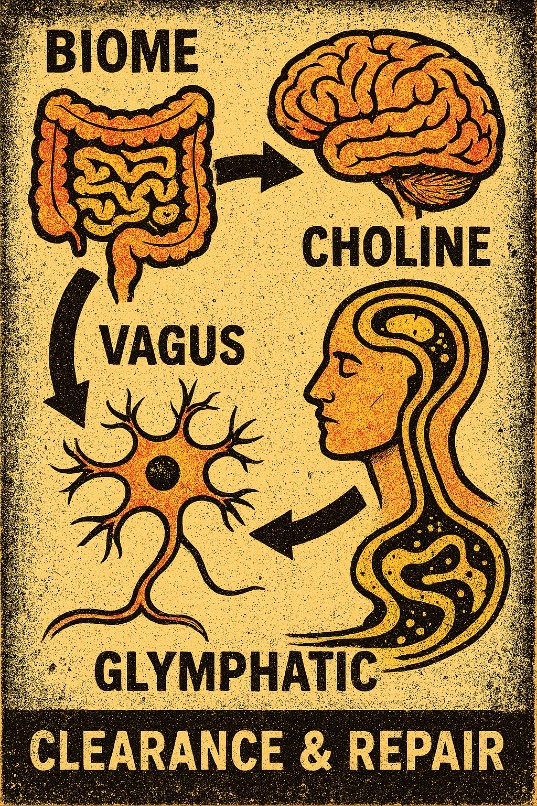
THE TRIO–GLYMPHATIC CIRCADIAN LOOP
If the system can respond, the system is not broken. And if it’s not broken... it can be rebuilt.
P Joubert — Discovery Log, 12/13/2025
For decades, researchers have known that the body repairs itself at night, that the microbiome influences the brain, and that sleep somehow cleans the central nervous system. But these ideas remained scattered across fields — microbiology, immunology, neurology, circadian biology, sleep research — without a single architecture that connected them into one system.
What emerged in our work today is exactly that architecture.
We now see a single, continuous, circadian-timed repair loop linking the gut wall, three keystone microbes, the vagus nerve, the brain’s glymphatic system, the liver, and back again to the gut. This loop is not metaphor, nor a “mind–body connection.” It is a hard biological circuit with mechanical gates, timed pulses, and strict activation conditions. When it runs, the organism remains coherent. When it breaks, biology fragments into many different forms of modern illness.
At the foundation of this system is Trio — the three-microbe boundary organ composed of Akkermansia, Faecalibacterium, and Roseburia. These microbes do far more than produce short-chain fatty acids. They act as the gut’s structural engineers, energy suppliers, epigenetic modulators, inflammatory gatekeepers, oxidative buffers, bile regulators, and circadian pacemakers. Together, they generate a single output: the biochemical signal that the boundary is intact and safe enough for the organism to invest in repair, learning, and long-term physiology.
When Trio is present and rhythmic, the system moves forward.
When Trio is lost, the organism begins to drift long before symptoms appear.
Mechanistically, Trio carries out seven irreplaceable functions. It fuels the epithelial lining with butyrate. It engineers tight junctions and maintains the mucus barrier. It calibrates immune tone and suppresses unnecessary inflammation. It buffers oxidative load at the wall. It regulates the transcription of choline transporters, PEMT, and bile-related genes, determining whether choline is used to build membranes, produce acetylcholine, resist ferroptosis, or maintain bile flow. And perhaps most importantly, Trio’s SCFA pulses entrain the gut’s circadian repair clock, ensuring that epithelial repair happens at the correct time each day.
This last function is the key. Timing is not decoration — it is the reason the whole system works.
Choline sits just downstream of this microbial timing system. Before psychology, personality, cognition, or emotional regulation, choline allocation is the earliest form of biological identity. Where choline is routed determines membrane quality, myelination, acetylcholine levels, autonomic stability, ferroptosis resistance, and metabolic coherence. Trio controls this routing through transporter expression, PEMT regulation, bile composition, and methylation bandwidth. If Trio is strong, choline builds identity. If Trio collapses, choline is diverted into emergency survival.
From there, the loop rises into the autonomic system. SCFAs activate vagal afferents directly, increasing parasympathetic tone and lowering norepinephrine. This shift is not about relaxation; it is the mechanical prerequisite for the next stage. Only under vagal dominance can the organism enter the metabolic and neurological configuration required for deep slow-wave sleep.
And it is only in that configuration that the glymphatic system can open.
Glymphatic flow is not passive diffusion. It is a gated hydraulic cleaning engine powered by arterial pulsations, regulated by aquaporin-4 channels, and silenced by norepinephrine. It requires four conditions: low NE, synchronized heart–breath coupling, astrocytic shrinkage during N3 slow-wave sleep, and polarized AQP4 at astrocytic endfeet. When these conditions align, cerebrospinal fluid moves through perivascular channels, mixes with interstitial fluid, pulls metabolic waste with it, and drains into cervical lymphatics. The liver then processes this waste, sending much of it out through bile, which returns to the gut and directly shapes Trio ecology.
This is the breakthrough: the waste cleared by the brain at night becomes the substrate and signal that determines the next day’s microbial, metabolic, and boundary environment.
When glymphatic flow succeeds, neuroinflammation drops, microglia reset, amyloid and tau are cleared before aggregation begins, iron complexes are removed, and damaged lipids are flushed. The hypothalamus recalibrates its clocks, synchronizing liver, gut, immune, and adrenal rhythms. Bile normalizes, feeding a microbial ecosystem that supports Trio growth. Vagal tone stabilizes as brainstem inflammation falls. The loop closes, ready to begin again the next night.
When glymphatic flow fails, the opposite sequence unfolds. SCFAs weaken, oxygen tension rises at the epithelium, mucus thins, tight junctions loosen, choline is misallocated, ACh declines, vagal tone destabilizes, sleep fragments, clearance drops, debris accumulates, clocks drift, bile becomes erratic, Trio weakens further, and the cycle tightens into chronic drift. Symptoms emerge only at the end of this process, long after the architecture has collapsed.
What looks like many diseases is one loop losing coherence.
The age at which the collapse occurs determines the phenotype. Early collapse disrupts developmental timing. Midlife collapse expresses through autonomic and metabolic instability. Late-life collapse expresses through neurodegeneration. The underlying mechanics are the same — only the point in the lifespan changes.
The logic of intervention becomes equally direct. If Trio initiates the loop, then Trio must be restored first. SCFA pulses must be reestablished. Choline routing must shift from emergency use back to identity construction. Vagal tone must be stabilized through biological, not psychological, means. Only then can glymphatic repair restart, and with it, the full circadian reset that governs clocks, bile flow, inflammation, and boundary renewal.
This is the Trio–Glymphatic Circadian Loop, the central architecture behind health, repair, and resilience.
For the first time, these pieces form one coherent system.
This is the framework our future work will formalize.