NICOTINE AND THE CHOLINE TRUTH
There is something deeply uncomfortable about nicotine.
Not because it is mysterious. Quite the opposite. We know an enormous amount about it. We know that it is addictive. We know that smoking tobacco is extraordinarily harmful. We know that combustion produces a toxic chemical mixture responsible for much of the disease associated with smoking.
NICOTINE AND THE CHOLINE TRUTH
Why a molecule we were taught to fear keeps turning up at the intersection of the gut, brain, immunity and disease
There is something deeply uncomfortable about nicotine.
Not because it is mysterious. Quite the opposite. We know an enormous amount about it. We know that it is addictive. We know that smoking tobacco is extraordinarily harmful. We know that combustion produces a toxic chemical mixture responsible for much of the disease associated with smoking.
And yet nicotine itself keeps turning up in places where nobody expected it.
Researchers have investigated nicotine and cholinergic signalling in inflammatory bowel disease. Neuroscientists have spent decades studying the loss of cholinergic function in Alzheimer’s disease. Nicotinic receptors are found throughout the nervous system and, rather more intriguingly, on cells of the immune system. The vagus nerve communicates with the organs of the body through pathways in which acetylcholine plays a central role. Then there is the growing interest in nicotine for attention, cognition, fatigue and neurological symptoms.
None of this means nicotine is a miracle drug. It means something much more interesting.
Nicotine is touching a biological system that is far more important than nicotine itself. That system is the cholinergic system. And once you start following it, the rabbit hole gets surprisingly deep.
Because acetylcholine leads to choline. Choline leads into membrane biology, lipid metabolism and cellular energetics. The vagus connects cholinergic signalling to the gut and immune system. The gut contains its own enormous nervous system and an ecosystem of microbes capable of transforming the chemical environment around it. Microbial metabolites can alter epithelial, immune and metabolic function.
Suddenly, nicotine is no longer the story. It is the molecule that opened the door.
The Wrong Question
The internet has become fascinated with nicotine — patches, gum, experimental protocols, claims about concentration, brain fog, inflammation and neurological recovery. The usual question is: “Does nicotine work?”
It is an understandable question, but biologically it is a rather primitive one. A drug can produce an effect without repairing the reason the effect was needed. A receptor can be activated while the system surrounding that receptor remains dysfunctional. A signal can be amplified while the infrastructure carrying the signal remains damaged.
If a light switch still works but half the electrical system in the building is failing, turning the switch on tells you something about the switch. It does not tell you that the building is healthy.
Nicotine gives us precisely this kind of information. It is capable of activating nicotinic acetylcholine receptors because those receptors evolved to respond to acetylcholine. The receptor did not evolve for nicotine. Nicotine found the receptor. That difference is the beginning of the story.
Meet Acetylcholine
Acetylcholine is one of the oldest and most important signalling molecules in animal biology. We usually encounter it in textbooks as a neurotransmitter. It helps neurons communicate. It participates in muscle contraction. It is involved in autonomic nervous-system function. It contributes to attention, learning and memory.
But the more we learn about acetylcholine, the harder it becomes to keep it inside the category of “brain chemical.” Acetylcholine is part of a distributed signalling system that reaches far beyond the brain.
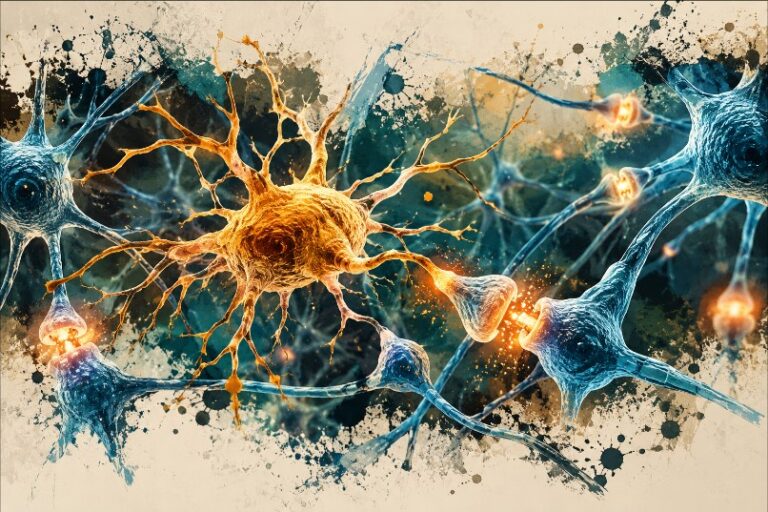
There are cholinergic neurons in the central and peripheral nervous systems. The enteric nervous system contains extensive cholinergic circuitry. Autonomic pathways use acetylcholine. And immune cells can express cholinergic receptors and, in some contexts, possess the machinery to produce acetylcholine themselves.
This matters enormously. Because it means acetylcholine can participate in communication between systems that medicine traditionally studies separately:
- Brain
- Gut
- Immune system
- Autonomic nervous system
- Peripheral tissues
These aren’t separate conversations. They are overlapping conversations conducted through multiple signalling languages. And acetylcholine is one of them.
The Receptor with a Strange Name
There is a wonderful historical accident hidden in the terminology. The receptors activated by acetylcholine are divided broadly into muscarinic and nicotinic receptors. The name “nicotinic” comes from nicotine because nicotine was found to reproduce some of the effects associated with acetylcholine. But the receptor’s natural ligand is acetylcholine. Nicotine is the impostor.
That makes the phrase “nicotinic acetylcholine receptor” much more informative than simply saying “nicotine receptor.” It tells us exactly what the receptor belongs to. The receptor belongs to the cholinergic system. Nicotine merely happens to be capable of activating it.
And these receptors are not confined to one place. Different nicotinic receptor subtypes are distributed across different tissues and cell populations, with different physiological consequences. Some are particularly important in neuronal communication. Others have attracted enormous interest because of their presence on immune cells. One of the most intensively studied is the α7 nicotinic acetylcholine receptor.
That receptor helped reveal something that would have sounded strange to an older generation of physiology students: the nervous system can directly influence immune behaviour through cholinergic signalling.
When the Nervous System Talks to Immunity
For a long time, the nervous system and immune system were taught almost as separate departments. The nervous system handled information. The immune system handled pathogens. The endocrine system handled hormones. The digestive system handled food.
Modern physiology has demolished those walls. The immune system receives signals from nerves. Nerves respond to immune activity. The intestine communicates continuously with the brain. Metabolites produced by microbes influence host cells. Hormones alter immune behaviour. Immune mediators influence neural function.
The body is not organised like a university. There are no walls between departments.
One of the clearest demonstrations of this interconnectedness is the cholinergic anti-inflammatory pathway. Research has shown that vagal signalling can participate in the regulation of inflammatory responses, with acetylcholine and nicotinic receptors such as α7nAChR playing important roles in experimental models.
The basic concept is elegant. A neural signal can influence immune-cell behaviour. That means inflammation is not simply something the immune system decides to do by itself. It exists within a larger regulatory network. And once again, nicotine enters the picture. If nicotine activates certain nicotinic receptors, it can perturb part of that network. The resulting physiological response may therefore tell us something about the network — not necessarily because nicotine is therapeutic, but because the receptor is real.
The Vagus Is Where the Story Starts to Get Weird
The vagus nerve is often described as the “wandering nerve,” and the name is deserved. It travels from the brainstem into the body, carrying information between the central nervous system and visceral organs. But even that description doesn’t quite capture what makes it fascinating.
The vagus is not simply a cable carrying commands from the brain. It is a major sensory pathway. The brain is constantly receiving information from the body. The gut is telling the brain about its mechanical state, chemical environment and internal activity. Peripheral tissues are reporting inflammatory and metabolic conditions. The brain integrates those signals and modifies autonomic output.
So the system behaves less like a command hierarchy and more like a continuous conversation. And acetylcholine is part of the language.
This immediately gives us a different way of looking at chronic disease:
- What happens when the conversation becomes distorted?
- What happens when the signal is present but the receiver is altered?
- What happens when the tissue producing the signal is metabolically constrained?
- What happens when inflammation changes receptor behaviour?
- What happens when the intestinal environment changes the signals entering the nervous system?
These are not hypothetical questions about a vague “gut-brain connection.” They are questions about identifiable biological pathways.
Choline Is Not Just a Precursor
This is where the nicotine story becomes much more interesting. Choline is commonly introduced as the nutrient from which the body makes acetylcholine. That is correct. It is also nowhere near the whole story.
Choline participates in several fundamental processes:
- It is a precursor for acetylcholine.
- It is incorporated into phosphatidylcholine, one of the major phospholipids of biological membranes.
- It contributes to lipid transport and metabolism.
- It can be oxidised to betaine, connecting it to methyl-group metabolism.
It therefore sits simultaneously inside signalling, structure and metabolism. That is a remarkable position for one nutrient.
The chemistry of acetylcholine itself is deceptively simple:
Choline + acetyl-CoA → acetylcholine
The reaction is catalysed by the enzyme choline acetyltransferase, or ChAT. But the simplicity of the equation hides the complexity of the system. Having choline available does not guarantee that every cell can produce acetylcholine at the rate required. The cell needs the appropriate enzyme machinery. It needs acetyl-CoA. It needs appropriate cellular energy and metabolic conditions. It needs vesicular and release machinery where relevant. The receiving cell needs the appropriate receptor. The downstream signalling apparatus needs to work. And the tissue has to be in a state in which that signal can actually produce the required physiological response.
The signal is only one part of the machine.
The Choline Pool Has Competition
There is another reason choline deserves more attention. The body does not maintain a giant warehouse labelled “CHOLINE — FOR ACETYLCHOLINE ONLY.” Biochemistry doesn’t work that way. Choline is distributed across multiple demands:
- Some enters acetylcholine synthesis.
- Some enters phosphatidylcholine production.
- Some participates in other metabolic pathways.
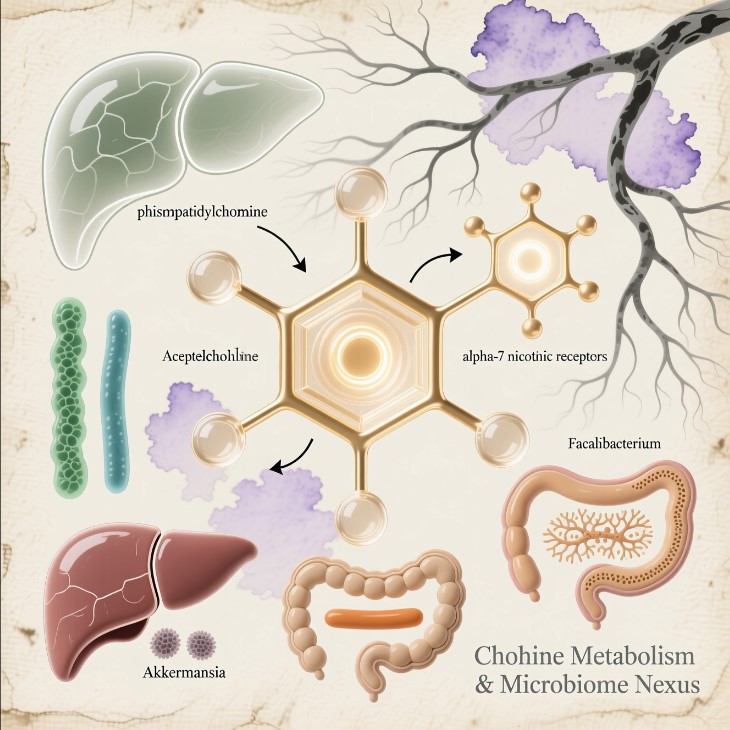
The liver has major roles in choline metabolism and lipid handling. Cell membranes require phospholipids. Lipoprotein metabolism requires phosphatidylcholine. Bile contains phospholipids involved in lipid digestion and protection of the biliary system.
So choline sits at a crossroads. If we change the state of one branch of the network, we potentially alter the availability and demand across other branches. This is why “eat more choline” is not a sufficient systems explanation. Nor is “you have enough choline because you eat eggs.” Nutrition is an input. Biology is what happens to the input afterward.
The Membrane Connection
This may be one of the least appreciated parts of the story. Choline contributes to phosphatidylcholine. Phosphatidylcholine contributes to membranes. And membranes are not passive plastic wrapping. They are active biological structures.
Receptors sit in them. Transporters cross them. Ion gradients are maintained across them. Signal complexes assemble within them. Mitochondria depend on specialised membranes. Vesicles bud from them. Neurons release neurotransmitters through membrane-dependent machinery. The membrane is where the outside world meets the inside world.
So a molecule involved in neurotransmitter synthesis is simultaneously involved in the architecture that allows cells to communicate. That gives choline an unusual position: it participates in both the message and the medium through which the message operates. This is one reason the choline story becomes much larger than a discussion about supplements or neurotransmitters.
And Then There Is the Microbiome
At this point the microbiome enters the story — but not as a magical factory producing whatever molecule we happen to be interested in. The microbiome is better understood as a vast biochemical ecosystem operating alongside host metabolism. Microbes consume substrates. They produce metabolites. They compete. They cooperate. They transform bile acids. They interact with mucus. They alter the local chemical environment. They generate short-chain fatty acids. They interact with epithelial and immune cells. And the host, in turn, changes the environment in which the microbes live.
This is an ecological system. The important question is therefore not simply “Which bacteria are present?” It is: “What is the ecosystem doing?” That is a much harder question. It is also the question that becomes increasingly important as microbiome science matures.
The Trio
This is where our Trio enters. Akkermansia, Faecalibacterium and Roseburia are not three magical organisms that explain everything. They are useful representatives of microbial functions that matter to intestinal ecology.
- Akkermansia muciniphila is closely associated with the mucus layer and the mucosal interface.
- Faecalibacterium prausnitzii is a major butyrate-producing organism associated with intestinal homeostasis and inflammatory states.
- Roseburia species are also important producers of butyrate and participate in carbohydrate fermentation within the anaerobic gut ecosystem.
Their importance may therefore be less about one bacterium performing one special task and more about what their presence tells us about the ecological state of the intestine. This is a subtle but important change in thinking. The question isn’t “Does Faecalibacterium make acetylcholine?” The better question is: “What does an intestinal ecosystem capable of sustaining these organisms produce for the host?” Now we are talking about metabolism.
Butyrate: The Microbial Molecule That Refuses to Stay in the Gut
Take butyrate. Certain intestinal bacteria produce it by fermenting dietary carbohydrates and other substrates. To call butyrate merely a bacterial waste product would be a spectacular understatement.
Colonocytes can use it as an energy substrate. It can influence epithelial biology. It can affect gene regulation, including through inhibition of certain histone deacetylases. It can influence immune responses. It can alter the metabolic environment of intestinal tissue.
A bacterial fermentation product therefore becomes part of host physiology. This gives us a far more realistic bridge between microbiology and neuroscience than the simplistic idea that “good bacteria make neurotransmitters.” The chain is something more like:
food substrate → microbial metabolism → metabolites → epithelial and immune signalling → tissue state → nervous-system communication
Now the gut microbiome is not a collection of tiny pharmaceutical companies. It is an ecological engine modifying the conditions under which human cells operate. That distinction matters.
The Gut Is a Chemical Landscape
Imagine the intestinal wall. On one side is the external world: food, microbes, metabolites and environmental compounds. On the other side are host tissues. Between them sits a sophisticated interface made of mucus, epithelial cells, junctional structures, immune surveillance, vascular supply and neural circuitry.
That interface is constantly negotiating: What enters? What stays outside? What is tolerated? What triggers an immune response? What is metabolised? What is transported? What is cleared? That is the biological terrain. And now choline has to operate inside it.
What If the Signal Is Perfect but the Terrain Is Wrong?
Suppose you provide plenty of choline. The molecule is there. But the tissue environment is inflamed. The epithelial barrier is altered. Microbial metabolism is different. Bile-acid signalling is altered. Cellular energetics are impaired. Membrane composition has changed. Autonomic signalling is disturbed.
Would simply increasing the substrate necessarily restore normal physiology? Of course not. The cell is not a blender. More ingredient does not guarantee more finished product. The metabolic machinery determines what happens to the ingredient. And that is the conceptual shift that makes the choline story interesting. Availability is not the same thing as usable capacity.
Nicotine Shows Us the Other End of the System
Nicotine approaches the problem from the opposite direction. Instead of supplying a precursor, it interacts directly with receptors. It effectively asks: “What happens if I activate this part of the signalling system from the outside?”
If the downstream system responds, we have learned something. The receptor exists. The receptor can respond. The cell has some capacity to translate the signal. That doesn’t mean the system is healthy. It means the system is perturbable. And perturbability is information.
A Biological System Can Be Alive and Still Be Constrained
This is becoming one of the recurring themes in our work. A tissue does not have to be destroyed to be dysfunctional. A cell can remain alive while operating below its normal functional range. A neuron can remain present while signalling efficiency changes. An immune cell can remain alive while its activation threshold shifts. An epithelial cell can remain present while barrier function changes. A mitochondrial network can remain intact while throughput falls. A microbial species can remain detectable while its ecological activity changes.
This is why looking only for absence can be misleading. Sometimes the important variable is not “Is it there?” but “What is it permitted to do?” That word — permitted — keeps appearing.
Permissiveness
Biology is full of conditional permissions. An enzyme requires the right substrate and environment. A receptor requires the correct ligand and cellular context. A stem cell requires a permissive niche. A bacterium requires a suitable ecological niche. A mitochondrial pathway requires substrates, cofactors and electron-flow conditions. An immune response requires activation signals and regulatory brakes. A repair process requires energy and building materials.
The organism is therefore continuously solving a permissions problem: What can happen here? What cannot happen? What is being blocked? What is being allowed? That is a very different way of looking at disease.
Why This Matters for Inflammation
Inflammation is supposed to be temporary. Something changes. The immune system responds. The threat is controlled. The response resolves. But resolution is not simply the absence of inflammation. It is an active biological process. Signals change. Immune cells change state. Metabolites change. Tissues repair. Damaged material is cleared. The system returns toward equilibrium.
The cholinergic anti-inflammatory pathway is interesting precisely because neural signalling participates in this regulatory landscape. The body has mechanisms capable of telling immune systems: enough. That does not mean acetylcholine is the master off-switch. It means the nervous and immune systems possess a communication channel through which inflammatory behaviour can be regulated. And nicotine can interact with part of that channel.
The Alzheimer’s Connection
Now take the same molecule into the brain. Cholinergic dysfunction has been associated with cognitive impairment in Alzheimer’s disease for decades. The loss of cholinergic neurons and signalling contributed to the development of one of the major symptomatic treatment strategies for Alzheimer’s: increasing the persistence of acetylcholine by inhibiting its breakdown.
But Alzheimer’s is obviously not caused by “too little acetylcholine.” The disease involves multiple interacting processes, including synaptic dysfunction, neuroinflammation, protein pathology, metabolic disturbances and progressive network failure. The cholinergic system is one part of that landscape. And that is exactly why it is interesting. The same signalling family can appear in neurology and immunology because the body uses the same communication machinery in multiple contexts. One molecule. Many tissues. Different outcomes.
And ADHD?
Attention is also influenced by cholinergic signalling. But attention is not an acetylcholine-only phenomenon. Dopamine and noradrenaline are central to established neurobiological models of ADHD, alongside broader network-level mechanisms. The interesting point is therefore not that ADHD is secretly a choline deficiency. It isn’t. The interesting point is that cholinergic signalling participates in the regulation of attention and cognitive state. Again, the system refuses to fit inside a single neurotransmitter. That is precisely what we should expect from biology.
The Same Pattern Appears in the Gut
The intestine is packed with cholinergic signalling. The enteric nervous system contains extensive networks regulating motility, secretion and other gastrointestinal functions. The autonomic nervous system interacts with these circuits. Immune cells occupy the same physical environment. Microbial metabolites modify the chemical landscape. The epithelium sits between microbial and host worlds.
So when nicotine changes intestinal physiology, we should not immediately ask which “one thing” it fixed. There are many possible levels of interaction: receptor activation, neural signalling, smooth-muscle function, secretory activity, immune signalling, inflammatory pathways, autonomic regulation. The gut is a network. Naturally, the response is a network response.
This Is Where the Nicotine Story Becomes a Systems Story
The conventional story is: nicotine → receptor → effect.
The systems story is: nicotine → receptor perturbation → cellular signalling → tissue response → network response.
And the network already exists inside a larger environment: microbiome + epithelium + immune system + metabolism + nervous system + endocrine system. The result is not one pathway. It is an interacting field of constraints and permissions. This is why the same receptor family can appear relevant to seemingly unrelated conditions. It is not necessarily because those conditions share one cause. They may share one vulnerable interface.
The Environmental Question
This naturally raises another question. What happens to cholinergic biology when the environment changes? Diet changes. Microbiome changes. Medications change. Inflammation changes. Sleep changes. Metabolism changes. Environmental exposures change.
The original nicotine discussion tried to place glyphosate at the centre of this story. We don’t need to do that. Environmental chemicals are worth investigating, but causal chains must be demonstrated rather than assumed. The useful question is broader: Which environmental and physiological changes alter the ecological and metabolic conditions under which cholinergic signalling operates?
That question leaves room for pesticides. It also leaves room for antibiotics, diet, alcohol, stress, infection, sleep disruption, metabolic disease, age, medications — and factors we haven’t thought of yet. A good model should not require one villain.
The Choline Truth
So what is the truth about choline? It is neither the miracle nutrient nor a trivial dietary component. Choline is a biochemical crossroads. It feeds acetylcholine synthesis. It contributes to membrane phospholipids. It participates in methyl metabolism. It intersects with hepatic and lipid physiology. Its metabolism is influenced by host and microbial processes. Its availability is only one variable. Its utilisation depends on the machinery of the cells receiving it. And acetylcholine production is only one branch of what the body can do with the choline pool.
That is why the title of this article is not “Choline Deficiency Is Causing Modern Disease.” That would be another reductionist story. The more interesting proposition is: Choline sits at an intersection where nutrition, membrane biology, metabolism and signalling meet. And the condition of the surrounding terrain determines what happens at that intersection.
The Receptor Does Not Live in a Vacuum
This is perhaps the most important concept to carry forward. When we see a receptor, we tend to imagine a lock waiting for a key. But the lock is embedded in a membrane. The membrane exists inside a cell. The cell exists inside tissue. The tissue exists inside an organism. The organism exists inside an ecological environment. Every level influences the others.
A receptor cannot be understood completely without understanding the cell. A cell cannot be understood completely without understanding the tissue. A tissue cannot be understood completely without understanding its inputs and outputs. The network is the unit. That is where our lens begins to become useful.
From Molecules to Relationships
The deeper we go, the less interesting individual molecules become in isolation. What matters is the relationship:
- Choline with acetyl-CoA
- Acetylcholine with its receptors
- The receptor with the immune cell
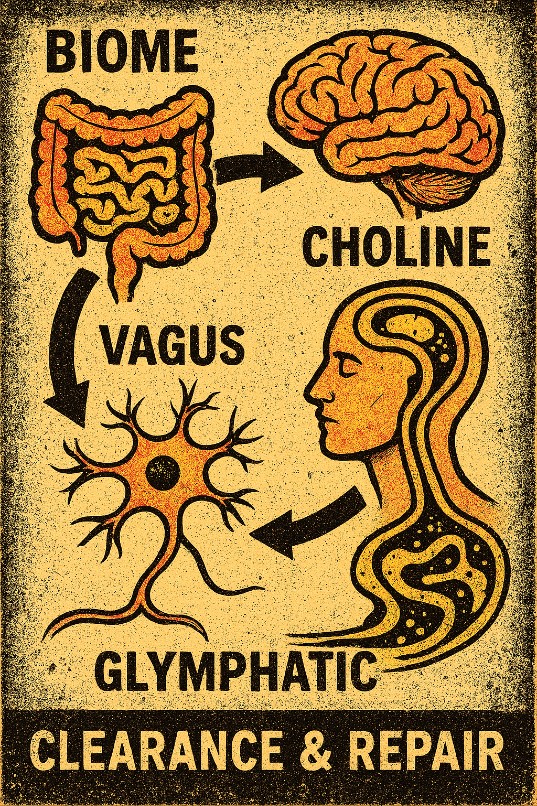
- The vagus with the gut
- The gut with its microbial ecosystem
- Microbial metabolism with epithelial function
- Epithelial function with immune tone
- Immune tone with neural signalling
- Metabolic state with cellular responsiveness
- Clearance with resolution
These relationships are where physiology lives. Disease may emerge when one or more of these relationships become constrained.
The Three Questions
This gives us three increasingly useful questions:
- Is the component present?
- Is it functional?
- Is the surrounding system permitting it to perform its function?
Those are very different questions. A bacterium can be present but metabolically inactive. A receptor can be present but desensitised. A nutrient can be present but poorly utilised. A neuron can be present but functionally impaired. A tissue can be structurally intact but metabolically constrained.
This is why conventional measurements sometimes leave us staring at apparently contradictory results. The component is there. The function isn’t. That contradiction may not be a contradiction at all. It may be the clue.
Nicotine as a Window
And this brings us back to where we started. Why does nicotine keep appearing in research surrounding apparently unrelated diseases? Because nicotine happens to perturb a highly conserved signalling system. It activates nicotinic acetylcholine receptors. Those receptors sit within neural, autonomic and immune networks. The networks sit within tissues. The tissues sit within metabolic and ecological environments.
Therefore the response to nicotine can potentially reveal something about the state of the system it is perturbing. But the response does not tell us automatically what caused that state. That distinction is crucial.
Nicotine is not proof of a choline deficiency. It is not proof of microbial collapse. It is not proof of vagal dysfunction. It is not proof that one environmental exposure caused the problem. It is a perturbation. And perturbations are how we learn about systems.
The Question That Follows
Imagine that two people receive exactly the same cholinergic stimulus. One responds strongly. The other barely responds. What determines the difference?
That is where the interesting experiment begins. Perhaps receptor expression differs. Perhaps receptor sensitivity differs. Perhaps membrane composition differs. Perhaps inflammatory signalling changes the downstream pathway. Perhaps metabolic state limits the response. Perhaps autonomic circuitry differs. Perhaps microbial metabolites alter the tissue environment. Perhaps several of these occur together.
Now we have something to investigate. The question has moved from “Does nicotine work?” to “What determines cholinergic responsiveness?” That is a much better question.
The Terrain Lens
This is where the broader model enters. We have been increasingly interested in three fundamental domains:
- Boundary — What separates the organism from its environment and determines what crosses that interface?
- Identity — What allows a cell or tissue to maintain its functional state and respond appropriately?
- Clearance — What allows signals, damaged material, inflammatory mediators and metabolic products to be processed and removed so that transient states do not become persistent ones?
Now look at the nicotine/choline system through those three lenses. The intestinal boundary determines what the host encounters. The microbial ecosystem changes the chemical environment around that boundary. Choline contributes to membrane and signalling biology. Cellular metabolic state determines what can be built and maintained. Cholinergic receptors determine how signals are received. The immune system responds. The autonomic system communicates. Clearance determines whether the consequences resolve.
Suddenly the pieces stop looking like separate subjects. They become layers of one biological system.
And That Changes the Meaning of “Disease”
Disease is usually presented as a thing. A disease has a name. A patient has the disease. A treatment targets the disease. But biological systems do not necessarily operate in categories. They operate in states. A system can move from one state to another. It can compensate. It can adapt. It can become constrained. It can cross thresholds. It can sometimes recover.
And different diseases may occupy different regions of the same underlying physiological landscape. That does not make the diseases identical. It means their mechanisms may intersect. The cholinergic system is one such intersection.
The Most Interesting Possibility
Perhaps the most important discovery here is not that nicotine affects acetylcholine signalling. We already know that. The deeper possibility is that the response to a perturbation can tell us something about the hidden state of the biological system. That is a very different proposition.
It means we should stop asking only what a molecule does. We should ask what the system’s response reveals. A signal becomes a probe. A perturbation becomes information. A symptom becomes an output. And the terrain becomes something we can attempt to measure.
From Trio to Metabolic Function
This also changes how we think about the Trio. We do not need to claim that three bacterial species manufacture neurotransmitters for the brain. The biology is more interesting than that. The Trio represents organisms associated with particular ecological and metabolic functions in the intestinal environment. Their presence tells us something about the ecosystem. Their activity tells us more. Their metabolites tell us more again. And the host response to those metabolites tells us something about the interface between microbial ecology and human physiology.
The future of microbiome science is unlikely to be “Take bacterium X because it is good.” It is increasingly likely to be: “What metabolic function is missing, what organism performs it, what substrate permits it, and what host process responds to its products?” That is the level at which our work becomes interesting.
The Substrate Is Not the Signal
A food contains choline. That does not mean the food has delivered acetylcholine. The gut contains bacteria. That does not mean those bacteria have delivered a neurotransmitter to the brain. A receptor exists. That does not mean the downstream system can respond normally. A metabolite exists. That does not mean the tissue is capable of using it correctly.
At every stage, there is a transformation: substrate → flux → product → receptor → response → adaptation. And at every stage, terrain can alter the outcome. That is the central idea.
The Body Does Not Run on Ingredients
It runs on relationships. Choline matters because of what the cell does with it. Butyrate matters because of what tissue does with it. Acetylcholine matters because of what the receptor does with it. A receptor matters because of what the cell does after activation. A microbial species matters because of what it contributes to the ecosystem. A signal matters because of what happens after the signal arrives. And a disease state matters because of the network that maintains it.
That is why the question of “what are you deficient in?” can sometimes be less informative than: “What biological operation has become constrained?”
The Nicotine Clue
Perhaps that is what nicotine has been trying to tell us all along. Not “Smoke me.” Not “Patch me.” Not “I am the cure.” Something much more useful:
Look at this receptor.
Then look at the signalling system around it.
Then look at the tissue.
Then look at the metabolism.
Then look at the environment.
And eventually: look at the whole system.
That is where the investigation gets interesting.
Where We Go from Here
The next generation of this work should not be built around finding a single magic molecule. It should be built around identifying constraints.
- If cholinergic responsiveness changes, what changed upstream?
- If the gut becomes inflamed, what changed in its ecological and metabolic environment?
- If microbial metabolites change, what changed in substrate availability?
- If a receptor remains present but signalling changes, what changed in the cellular terrain?
- If a tissue becomes less capable of returning to baseline, what changed in clearance?
- And if several apparently unrelated diseases repeatedly show disturbances around the same biological interfaces, are we looking at coincidence — or at shared system vulnerabilities?
Those are the questions worth taking into the laboratory.
Nicotine Was Never the Destination
We began with an apparently ridiculous observation. Why is nicotine suddenly appearing in conversations about colitis, cognition, Alzheimer’s, inflammation, fatigue and neurological function?
The answer is not that nicotine has secretly become a miracle substance. It is that nicotine touches an ancient and widely distributed signalling system. That system uses acetylcholine. Acetylcholine requires choline. Choline participates in membrane biology and metabolism. The nervous system communicates with the immune system through cholinergic pathways. The vagus connects the brain with the viscera. The gut contains its own nervous system. The microbial ecosystem changes the chemistry of the intestinal environment. Microbial metabolites influence host tissue. Host tissue determines how signals are received. And the condition of the terrain determines what the system is capable of doing with those signals.
The molecule that looked like the story turns out to be the clue that gets us into the story. Nicotine is not the answer. It is the perturbation that makes the question visible.
And the question is no longer simply what nicotine does. The question is: What determines whether a biological system can receive, interpret and complete a signal?
That question reaches from the gut to the brain. From the membrane to the mitochondrion. From microbes to immunity. From metabolism to the nervous system. And perhaps, eventually, from disease labels back to the terrain that produced them.
That is where the real investigation begins.