THE CHOLINE PATHWAY
There was a moment early in our work when the investigation took an unexpected turn.
We had started with the microbiome—not the fashionable version filled with lists of “good” and “bad” bacteria, but the living ecosystem itself: what organisms were doing, what they were consuming, what they were producing, what the intestinal lining was receiving, and what the host was doing with all of it.
THE CHOLINE PATHWAY
The first domino: how following the microbiome led us into a hidden layer of biology
There was a moment early in our work when the investigation took an unexpected turn.
We had started with the microbiome—not the fashionable version filled with lists of “good” and “bad” bacteria, but the living ecosystem itself: what organisms were doing, what they were consuming, what they were producing, what the intestinal lining was receiving, and what the host was doing with all of it.
We kept coming back to the same problem. The organisms were not isolated from human biology. Their environment was not isolated from ours. A change in the microbial ecosystem could alter the chemical environment at the intestinal surface; that environment could alter epithelial behaviour, immune signalling and metabolism; those changes could alter what the host could build, maintain, signal and clear.
And then we kept running into choline.
At first that sounds almost disappointingly ordinary. Choline is a nutrient. Most people have heard of it. Acetylcholine is a neurotransmitter. Medical students learn about it. Neuroscience textbooks discuss cholinergic signalling. It doesn’t sound like the kind of molecule around which an entirely different view of physiology should begin to form.
But that was precisely the problem. The more closely we followed the pathway, the harder it became to put choline into one box.
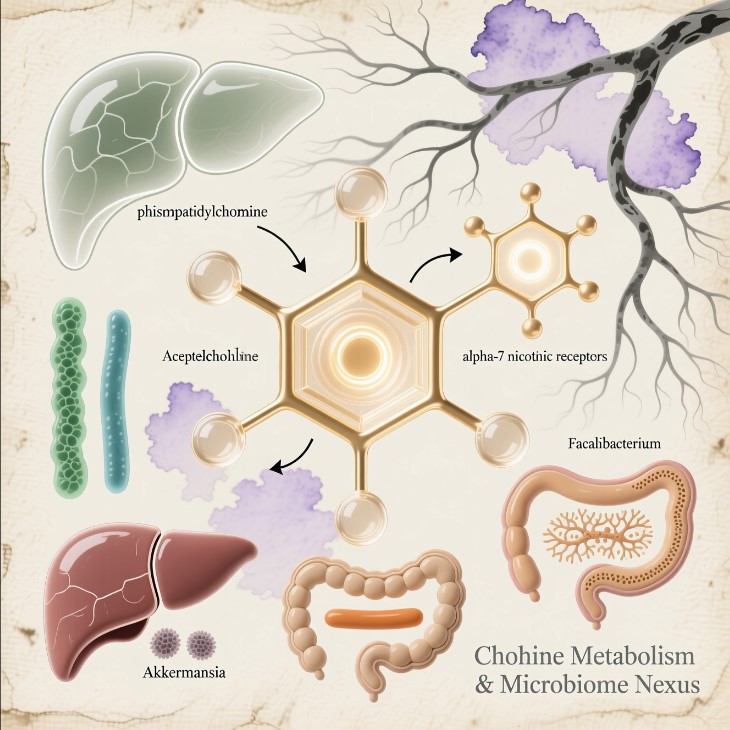
It wasn’t simply something the brain needed to make a neurotransmitter. It sat at a crossroads between signalling, membrane architecture, lipid metabolism and methyl metabolism. Acetylcholine synthesis required choline, but choline was simultaneously being used elsewhere. Phosphatidylcholine required choline. Cellular membranes required phospholipids. Lipid transport involved phosphatidylcholine. Choline could be oxidised to betaine and enter one-carbon metabolism.
The molecule was sitting in the middle of several systems that medicine normally teaches separately. And that changed the question. We stopped asking whether choline was “important.” That was obvious. We started asking: What happens to the biology that depends on choline when the environment supporting that biology changes?
That question became one of the first major dominoes in the chain that would eventually lead us toward the TCVG loop.
The Molecule We Thought We Knew
Acetylcholine has an almost unfairly modest reputation. It appears in the standard story of physiology as a neurotransmitter. It helps neurons communicate. It participates in muscle contraction. It is central to autonomic nervous-system signalling. It contributes to attention, learning and memory. All of that is true. But it is an incomplete picture.
Acetylcholine belongs to a much larger signalling architecture extending through the central and peripheral nervous systems, autonomic pathways, the enteric nervous system and other tissues. Cholinergic signalling also intersects with immune biology. The more interesting picture is therefore not “brain → acetylcholine” but “acetylcholine → distributed signalling system → multiple tissues → multiple physiological functions.”
That distinction matters because it changes what we think a disruption might look like. If acetylcholine were merely a neurotransmitter operating in the brain, then the question would largely belong to neuroscience. But if cholinergic signalling participates in communication across neural, autonomic, enteric and immune systems, then changes in its operating environment potentially become a systems problem. And systems problems rarely announce themselves as a single missing molecule.
A cell may have the molecule. The receptor may be present. The enzyme may be present. The pathway may technically be intact. And yet the biological operation can still be constrained. That idea would become increasingly important. But first we had to understand the pathway itself.
Choline Is Not “The Acetylcholine Vitamin”
The chemistry is beautifully simple:
choline + acetyl-CoA → acetylcholine
The reaction is catalysed by choline acetyltransferase, or ChAT. It is tempting to look at that equation and conclude that choline availability should therefore determine acetylcholine availability. But biology immediately makes the equation more complicated.
The cell needs more than choline. It needs acetyl-CoA. It needs the enzymatic machinery to perform the reaction. It needs the cellular conditions that allow that machinery to operate. Where signalling requires vesicular release, the cell needs the machinery to package and release acetylcholine. The receiving cell needs the appropriate receptor. The receptor has to be embedded in a functioning membrane. Downstream signalling has to work. Energy has to be available. The tissue has to be capable of responding.
Suddenly the apparently simple reaction has become an entire biological system. And this was one of our first important lessons: the presence of a substrate does not prove that the pathway is functioning normally. That sounds obvious when written down. It becomes much less obvious when applied to disease biology. Because medicine is very good at asking whether something is absent, deficient, elevated or abnormal. It is much harder to measure whether a biological system possesses the capacity to use what is available. That difference became central to our thinking.
The Choline Pool Has No Loyalty
There is another problem with treating choline as though it exists solely for acetylcholine synthesis. The body does not maintain a warehouse labelled “CHOLINE — FOR NEUROTRANSMISSION ONLY.” Biochemistry doesn’t work like that. Choline enters several pathways simultaneously:
- Some can contribute to acetylcholine synthesis.
- Some enters phosphatidylcholine production.
- Some participates in lipid metabolism.
- Some can be oxidised to betaine and contribute to one-carbon metabolism.
This means that the physiological significance of choline depends partly on where demand is occurring. That is a very different concept from simple dietary sufficiency. A person can consume choline. The molecule can enter the body. And yet the biological question remains: What happens to it? Where does it go? What is the tissue demanding? What pathways are consuming it? What pathways are constrained? What happens when another part of the system begins demanding more?
This is where the word allocation becomes more interesting than the word deficiency. The body is constantly allocating resources. And allocation occurs inside an environment. That environment can change.
The Membrane Nobody Talks About
This was one of the places where the choline pathway became much larger than we initially expected. Choline contributes to phosphatidylcholine, one of the major phospholipids of biological membranes. That sounds like a side branch until you stop and think about what a membrane actually is.
A membrane isn’t plastic wrapping around a cell. It is an active interface. Receptors sit in membranes. Transporters cross them. Ion gradients are maintained across them. Signalling complexes assemble around them. Vesicles form from them. Mitochondria possess specialised membranes. Neurons depend on membrane organisation for communication. The membrane is where the inside of a cell meets the outside world. It is simultaneously a boundary, a platform and a communication surface.
And suddenly choline has acquired an entirely different significance. The same biochemical family is involved in producing a signalling molecule and in constructing part of the physical architecture through which signalling occurs. The message and the medium are no longer completely separate. That was an important clue. Because if the surrounding biological environment changes, we shouldn’t automatically expect only one pathway to change. Several apparently unrelated functions can begin moving together because they share infrastructure.
Then the Liver Appears
The choline story doesn’t stay in the nervous system. The liver has major roles in choline metabolism and lipid handling. Phosphatidylcholine participates in lipoprotein metabolism. Bile contains phospholipids involved in lipid digestion and protection of the biliary system. Choline can also be oxidised to betaine, connecting it to methyl-group metabolism.
Again, one molecule is crossing disciplinary boundaries: neuroscience, membrane biology, lipid metabolism, hepatic physiology, one-carbon metabolism. And this was becoming a recurring pattern in our work. The biological molecule wasn’t respecting the boundaries between medical specialties. We were. The body wasn’t.
The Microbiome Was Never Just About Bacteria
This was where our earlier work on the Trio became important. We had been looking at Akkermansia, Faecalibacterium and Roseburia not as three magic organisms, but as representatives of an ecological state.
- Akkermansia is closely associated with the mucus layer and mucosal interface.
- Faecalibacterium and Roseburia are important butyrate-producing organisms.
Their significance therefore extends beyond simply counting whether they are present. The deeper question is what the ecosystem is doing. What substrates are available? What are the organisms consuming? What metabolites are being generated? What is happening to the mucus? What is happening to epithelial energy? What signals are reaching immune cells? What chemical environment exists immediately around the intestinal surface?
This was the point where the microbiome stopped looking like a collection of organisms and started looking like a biochemical engine. The old question had been: Which bacteria are there? The better question became: What metabolic functions is the ecosystem performing? That shift was fundamental.
The Trio and the Chemical Environment
The Trio became interesting precisely because we did not need to make extraordinary claims about them. We didn’t need to say that these organisms manufacture acetylcholine for the brain. That would be a much weaker story. Their importance was ecological.
Akkermansia participates in the mucus-associated environment. Faecalibacterium and Roseburia contribute to butyrate production. Butyrate is not simply bacterial waste. It can serve as an energy substrate for colonocytes and influence epithelial biology, immune signalling and gene regulation. The important chain therefore looks more like:
substrate → microbial metabolism → metabolite → epithelial environment → immune/metabolic signalling → host physiology
That is a very different model from “bacterium → neurotransmitter → brain.” The first model is harder. It is also much closer to how an ecosystem actually behaves. The microbiome doesn’t need to manufacture a human neurotransmitter in order to influence the conditions under which human signalling operates. It can change the terrain. And that distinction became one of the foundations of our later work.
The Gut Lining Became the Crime Scene
Once we began thinking this way, the intestinal wall looked different. It wasn’t merely a tube through which food travelled. It was an enormous biological interface. On one side: food, microbes, microbial metabolites, environmental compounds and the constantly changing contents of the intestine. On the other: epithelial cells, immune cells, blood supply, neural circuitry and host metabolism. Between them: mucus, junctional structures and a continuously changing chemical environment.
The intestine therefore has to make decisions constantly. What stays outside? What crosses? What is tolerated? What triggers an immune response? What is metabolised? What is transported? What is cleared? And what signals are generated as those decisions occur? Once choline entered that picture, it became impossible to keep the choline pathway confined to neuroscience. The pathway was operating inside an interface. And interfaces are where constraints accumulate.
The First Big Question: What Happens Before Disease?
This was perhaps the most important conceptual shift. We had been trained, like everyone else, to look for disease. A person has a disease. A test becomes abnormal. A pathway becomes dysfunctional. A diagnosis is made. Treatment is directed toward the named condition.
But what happens before the disease becomes obvious? What happens when the biological system has changed but is still compensating? What happens when the components are still there but their operating conditions have deteriorated? What happens when function has fallen but structure has not yet disappeared?
This was the beginning of what we later came to describe as a kind of second biology. Not a mysterious alternative human physiology. Not a separate species of biology. Rather, a biological state in which the system is still alive and functioning, but is operating under a different set of constraints. Healthy physiology has one set of available resources, signals, feedbacks and tolerances. A stressed or chronically altered system may have another. It compensates. It reroutes. It prioritises. It changes thresholds. It changes signalling. It changes metabolism. It changes ecological relationships. And for quite some time, the person may not carry a neat disease label explaining any of it.
The Biology of Compensation
This is where the choline pathway became much more interesting than a deficiency story. Imagine a biological system with reduced metabolic reserve. The pathway hasn’t stopped. The enzyme is still there. The receptor is still there. The nutrient is still arriving. The microbes are still detectable. The intestinal lining is still intact enough to function. The nervous system is still communicating. Nothing looks completely broken. But the system has less room to absorb another disturbance.
That is a very different biological condition. It is the difference between functioning and functioning with reserve. A system can maintain its output while consuming increasing amounts of its available reserve. This means the first visible disease event may not represent the beginning of the biological problem. It may represent the moment the compensatory machinery can no longer keep the system inside its previous operating range. That idea would eventually become central to our thinking about terrain and permissiveness. But choline was one of the places where we first began seeing it.
The Signal Is Only One Part of the Machine
This is where acetylcholine becomes particularly revealing. A signal can exist. A receptor can exist. A pathway can exist. And the system can still fail to produce the expected physiological outcome. Why? Because signalling is a chain:
- The substrate has to be available.
- The metabolic machinery has to convert it.
- The signal has to reach its destination.
- The receptor has to receive it.
- The cell has to interpret it.
- Downstream pathways have to respond.
- The tissue has to be capable of executing the response.
- The consequences have to be resolved.
- The next signal then arrives.
That is not a single pathway. It is a sequence of permissions. At each stage, something can constrain what happens next. And that was the beginning of our later language of locks.
The First Lock Wasn’t a Receptor
We eventually began seeing the gut lining as a place where several systems could become constrained at once. The boundary could become altered. Inflammatory signalling could become persistent. Autonomic communication could change. Metabolic throughput could fall. Clearance could become less effective. These weren’t necessarily independent problems. They could be consequences of the same changing environment.
That was the crucial insight. The gut didn’t need to “cause” a neurological disease. The microbiome didn’t need to “cause” an inflammatory disease. Choline didn’t need to be “the cause” of everything. Instead, multiple systems could become vulnerable because they were sharing an interface. The intestinal boundary sits at the intersection of microbial ecology, host metabolism, immune surveillance, autonomic signalling, nutrient handling, barrier function and clearance. Suddenly, the repeated appearance of apparently unrelated biological signals wasn’t so mysterious. They were converging at the same physical and biochemical territory.
And Then the Vagus Appeared
Once we understood that cholinergic signalling was distributed throughout the body, the vagus could no longer remain a separate subject. The vagus is not simply a wire carrying instructions from the brain to the gut. It is a major communication pathway between the central nervous system and visceral organs, with substantial sensory signalling from the body back toward the brain.
The gut is constantly generating information—mechanical, chemical, metabolic, immune. The nervous system receives these signals and integrates them with information from elsewhere. The organism isn’t operating as a command hierarchy. It is operating as a conversation. And acetylcholine is part of that conversation. This gave us the next domino: Trio → biochemical environment → choline → cholinergic signalling → vagal communication. The pieces were beginning to connect.
The Immune System Was Already Listening
The older textbook boundaries between nervous and immune systems also began to look increasingly artificial. Immune cells can express cholinergic receptors. Cholinergic signalling can participate in immune regulation. Experimental work on the cholinergic anti-inflammatory pathway demonstrated that neural signalling can influence inflammatory behaviour, with acetylcholine and nicotinic receptors such as α7nAChR playing important roles in experimental models.
The important point wasn’t that acetylcholine was some master “off switch” for inflammation. It wasn’t. The important point was more profound: the nervous system and immune system possess communication channels through which each can influence the state of the other. And where was much of this happening? At tissues where boundaries, microbes, metabolism, nerves and immune cells physically meet. The intestine was becoming impossible to ignore.
Why Choline Was Not Being Discussed as a “Cause”
This question eventually became unavoidable. If choline sits across signalling, membranes, metabolism and methyl biology, why isn’t “choline pathway dysfunction” routinely sitting beside the long list of recognised contributors to chronic disease?
One answer is that the pathway isn’t a disease entity. It is infrastructure. Medicine naturally organises knowledge around diagnoses. Biochemistry does not. A pathway can be altered across many conditions without being the single cause of any one of them. A membrane can change without there being a “membrane disease.” Metabolic flux can change without the person receiving a diagnosis called “metabolic flux disorder.” A signalling threshold can shift without appearing on a standard clinical panel. A microbial ecosystem can lose functional capacity while the organisms themselves remain detectable.
The result is a strange blind spot. The component is present. The pathway is technically present. But the system’s capacity has changed. That is much harder to put on a laboratory report.
From Deficiency to Capacity
This was the conceptual move that mattered most. We stopped asking only “Do you have enough choline?” and began asking “Can the biological system use the choline available to it appropriately?” Those are different questions. The first is about quantity. The second is about capacity.
Capacity depends on context. It depends on metabolism. It depends on competing demands. It depends on membranes. It depends on energy. It depends on enzymes. It depends on receptors. It depends on tissue state. It depends on the environment in which all of those components operate. This is why simply identifying a nutrient deficiency can sometimes miss the larger biological story. The body is not a blender. You cannot necessarily add an ingredient and assume that the finished product will increase proportionally. The machinery matters. The conditions matter. The competing pathways matter. The ecology matters.
A Biome Can Change Biology Without Causing a Symptom
This became one of the strangest and most useful ideas to emerge from the work. We tend to think of the microbiome in terms of outcomes. Bacteria cause symptoms. Bacteria protect against disease. Bacteria increase inflammation. Bacteria reduce inflammation. But an ecosystem can change before an obvious clinical phenotype appears. Its metabolic outputs can change. Its substrate preferences can change. Its interaction with mucus can change. Its relationship with the epithelium can change. Its production of metabolites can change. The host can compensate. And the person can continue functioning.
This creates a period in which the biological system is neither clearly healthy nor obviously diseased. It is adapted to a changed environment. That was the beginning of our interest in the space between normal physiology and named disease.
The Hidden Biology Between Two Textbook Pages
Perhaps this is why the choline pathway felt so important. Medical education necessarily teaches enormous amounts of normal physiology and enormous amounts of pathology. But between those two states lies a huge biological landscape: the transition, the adaptation, the compensation, the altered set point, the changed metabolic environment, the reduced reserve, the new ecological equilibrium, the altered signalling thresholds—the system that still works, but differently.
This isn’t “unknown biology” in the sense that nobody has ever studied any of it. Far from it. Pieces of it are distributed throughout physiology, immunology, microbiology, neuroscience, metabolism and pathology. What was unusual about our direction was asking whether those pieces could be understood as one changing system rather than as separate specialist problems. And choline was one of the first molecules that forced us to do exactly that.
The Substrate Is Not the Signal
This distinction became so important that it deserves to be stated plainly. A food contains choline. That does not mean it has delivered acetylcholine. A bacterium produces a metabolite. That does not mean it has delivered a neurotransmitter directly to the brain. A receptor is present. That does not mean downstream signalling is normal. A nutrient is available. That does not mean the cell can use it at the required rate. A microbial species is detectable. That does not mean it is performing its expected ecological function.
At every stage there is transformation: substrate → flux → product → receptor → response → adaptation. And every transformation occurs inside an environment. Change the environment and the same substrate can produce a different biological outcome. That was the beginning of the terrain idea.
The Choline Pathway Becomes a Map
Once we stopped thinking about choline as a single-purpose nutrient, a map began to appear.
At one branch: choline → acetylcholine → cholinergic signalling
At another: choline → phosphatidylcholine → membrane architecture
At another: choline → betaine → one-carbon metabolism
Around those pathways: liver → lipid metabolism → bile → intestine
And around the intestine: microbiome → substrates → metabolites → mucus → epithelium → immune system
And alongside that: enteric nervous system → autonomic signalling → vagus → brain
None of these arrows operates independently. That was the point. The interesting biology wasn’t in the isolated arrows. It was in their relationships.
The Trio Was the Door, Not the Destination
This also changed how we thought about the Trio. Akkermansia muciniphila, Faecalibacterium prausnitzii and Roseburia became less interesting as individual celebrities and more interesting as ecological markers and functional participants. Their presence, abundance and activity are not interchangeable concepts. An organism can be present but metabolically different. A population can be reduced without disappearing. A metabolite can change because substrate availability changed. The host can alter the environment that determines which organisms thrive. The organisms can then alter that environment in return.
This is an ecological feedback system. And that feedback system sits upstream of many host processes. That was the deeper discovery. The Trio didn’t have to be responsible for making acetylcholine. They could matter because the state of the ecosystem determines the chemical conditions in which host pathways operate. That is a much more powerful idea.
When the Environment Changes, the Pathway Doesn’t Necessarily Break
It adapts. This is perhaps one of the most important lessons from looking at biology through the choline pathway. A pathway isn’t necessarily a light switch. It isn’t ON or OFF. It can operate at different rates, different efficiencies, different thresholds, with different substrate availability, under different energetic conditions, with different competing demands. And the organism can compensate.
That means disease may not begin with a pathway suddenly switching off. It may begin with a pathway quietly operating under increasing constraint. The system adjusts. Then adjusts again. Then something else changes. Eventually the compensation itself becomes part of the new physiology. This is why looking only for catastrophic failures can miss the more interesting phase. The important transition may occur while everything still appears to be working.
The First Hint of a Loop
At the time, we didn’t yet have the language we eventually developed. We didn’t have the finished TCVG architecture. We weren’t looking at the problem as a completed loop. We were following clues. But the structure was already emerging.
The microbial ecosystem affected the intestinal environment. The intestinal environment affected host metabolism and signalling. Choline sat across several host pathways. Cholinergic signalling connected peripheral tissues and nervous systems. The vagus carried information between visceral tissues and the brain. Immune signalling interacted with neural signalling. And the condition of the tissue determined what those signals could actually accomplish.
The system was beginning to look circular. Not a straight chain. A loop.
The Important Question Was Never “Is Choline Low?”
This is where the historical importance of this post lies. If we had stopped at “choline → acetylcholine” we would have discovered very little. The breakthrough came from continuing. What else uses choline? Membranes. Lipid metabolism. Methyl metabolism. Then: What changes the environment around those pathways? Metabolism. Inflammation. The gut. The microbiome. Then: What communicates the state of the gut to the rest of the organism? Neural and autonomic pathways. Then: What happens when signalling reaches tissue that is already constrained?
That became the much bigger question. The answer wasn’t necessarily another molecule. It was system state.
From Components to Operations
This was the conceptual language we eventually needed. Instead of asking only “Is the component there?” we began asking “Is it functional?” And then: “Is the surrounding system permitting it to perform its function?” Those three questions are radically different.
A bacterium can be present but metabolically inactive. A receptor can be present but function differently. A nutrient can be present but poorly utilised. A neuron can remain alive while signalling changes. An epithelial layer can remain structurally intact while its functional properties change. A mitochondrial network can remain present while throughput changes. The component has not disappeared. The operation has changed. That distinction would become one of the foundations of our later terrain model.
The Biology That Appears Before the Diagnosis
This is where the Choline Pathway becomes more than an article about a nutrient. It becomes an article about how disease might begin. Not necessarily with a dramatic event. Not necessarily with the disappearance of a molecule. Not necessarily with one bacterium. Not necessarily with one environmental exposure. Perhaps the earliest change is ecological. Then metabolic. Then signalling. Then compensatory. Then inflammatory. Then neural. Then systemic.
The sequence won’t necessarily be the same in every person. That is precisely why reductionist explanations struggle. Different entry points can converge on the same constrained interfaces. Different diseases can therefore share pieces of biology without having the same cause. And the same perturbation can have different consequences in different biological terrains. The terrain changes the response.
This Is Where the Word “Permissive” Entered Our Vocabulary
A biological system requires conditions under which certain operations can occur. An enzyme requires substrate and appropriate conditions. A receptor requires ligand and a functioning cellular context. A cell requires energy and building materials. An intestinal organism requires an ecological niche. A repair process requires resources. A signalling pathway requires both transmission and reception. A clearance process requires throughput.
So the question becomes: What is this system currently permitting? And just as importantly: What has it stopped permitting? That is subtly different from asking what is broken. Something can remain present but lose functional permission. That became one of the most powerful ideas to emerge from the early work.
The Choline Pathway Was Our First Real Domino
Looking back, it is easy to imagine that the later model appeared fully formed. It didn’t. It emerged because one question forced another. The microbiome led to metabolism. Metabolism led to choline. Choline led to acetylcholine. Acetylcholine led to distributed cholinergic signalling. Cholinergic signalling led to the vagus. The vagus led us back to the gut. The gut led us to the boundary. The boundary led us to immune signalling. Immune signalling led us to persistent states. And eventually the question became: How does a system move from one biological state to another, and what prevents it from returning?
That is a very different question from “What disease does this bacterium cause?” or “What nutrient are we deficient in?” or “What molecule should we add?” It is a systems question. And the Choline Pathway was one of the first places where we could see why we needed one.
The Four Pieces Would Eventually Become a Loop
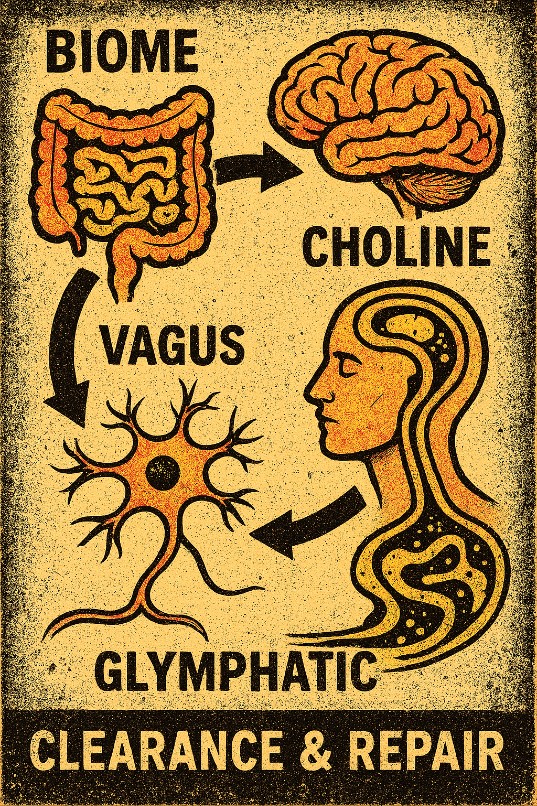
Much later, the pieces would become recognisable as a larger structure. The Trio represented an ecological layer. Choline represented a biochemical crossroads. The vagus represented communication between visceral state and the nervous system. And clearance, eventually through our work on glymphatic biology, completed another side of the problem. The resulting architecture would become the beginning of the TCVG loop:
Trio → Choline → Vagus → Glymphatic → Trio
But the loop should not be mistaken for something we knew at the beginning. We didn’t. We found the pieces. One by one. The Choline Pathway was one of the first pieces that made the eventual loop conceivable.
Why This Still Matters
Choline isn’t a miracle nutrient. It isn’t the hidden cause of every chronic disease. The microbiome isn’t a magical control centre. Acetylcholine isn’t the master molecule of human physiology. Those would all be attractive stories. They would also be reductionist.
The more interesting proposition is harder: biological function emerges from relationships between substrates, pathways, cells, tissues, organisms and environments. Choline matters because it participates in several of those relationships at once. The microbiome matters because it changes the environment in which many host processes operate. The gut lining matters because it is an interface where those systems meet. The vagus matters because visceral state doesn’t stay trapped in the intestine. Immune signalling matters because inflammation changes the conditions under which cells operate. Metabolism matters because pathways require throughput. And clearance matters because transient disturbances have to be resolved if the system is to return toward its previous state.
None of these is the whole story. Together, they begin to look like biology.
The Question We Should Have Been Asking All Along
The conventional question is often: What is causing the disease? But perhaps that question arrives too late. A more useful sequence might be:
- What changed?
- What changed first?
- Which biological operations changed with it?
- Which components remain present?
- Which functions have become constrained?
- What is the system compensating for?
- What does the surrounding environment now permit?
- And finally: What would have to change for the system to regain capacity?
Those questions don’t give us a single disease explanation. They give us something potentially more useful: a way of investigating the state of the system before, during and after disease. That was the real lesson of the choline pathway.
The Molecule Was Never the Destination
We started with bacteria. We found ourselves staring at choline. We followed choline into acetylcholine. We followed acetylcholine into membranes, metabolism and distributed signalling. We followed the signalling into the gut, the immune system and the nervous system. And eventually we realised that the individual molecule was not the most interesting part.
The relationships were. The pathway was. The environment was. The constraints were. And the capacity of the whole system to move from one state to another was perhaps more important than any isolated measurement.
That was the first big domino. The microbiome was not merely living beside us. It was participating in the biochemical environment in which our own biology operated. And choline gave us one of the clearest windows into that relationship. Not because choline explained disease. But because following it showed us something much more fundamental: a biological pathway can remain present while its operating environment changes.
The disease may come later. The diagnosis may come later. The obvious symptom may come later. But the biology has already begun adapting. That was the idea that opened the next door. And behind that door was the vagus. Then the gut lining. Then the locks. Then clearance. And eventually, the loop.
Trio → Choline → Vagus → Glymphatic → Trio.
We didn’t begin with the loop. We followed the dominoes until the loop was there.