HOW AGRICULTURE REFORM IS FOUNDATIONAL TO CORRECTING MODERN DISEASE
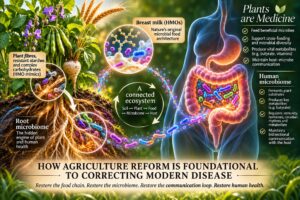
From breast-milk intelligence to agricultural disruption: why we cannot reconstruct human biology while undermining the ecosystem that sustains it
Research essay | 4 November 2026
There is a question that keeps returning throughout our investigations into the human microbiome.
We discuss probiotics, prebiotics, faecal microbiota transplantation, microbial metabolites, butyrate, Akkermansia, Faecalibacterium, Roseburia and the restoration of microbial diversity. We ask which organisms have disappeared, which substrates might encourage their return, and how we might restore the metabolic relationships that have been lost.
Eventually we arrive at a far more uncomfortable, and far more consequential, question.
What if we are trying to reconstruct the human microbiome using a food supply that no longer reliably provides the ecological conditions under which that microbiome evolved? What if the problem is not simply that we have lost organisms, but that we have also changed the food, the chemical environment and the agricultural ecosystem that once supported their existence?
This question takes us somewhere unexpected yet entirely logical: back to breast milk. And to one of the most sophisticated examples of ecological nutrition found in nature.
1. Breast milk: nature’s first microbial food architecture
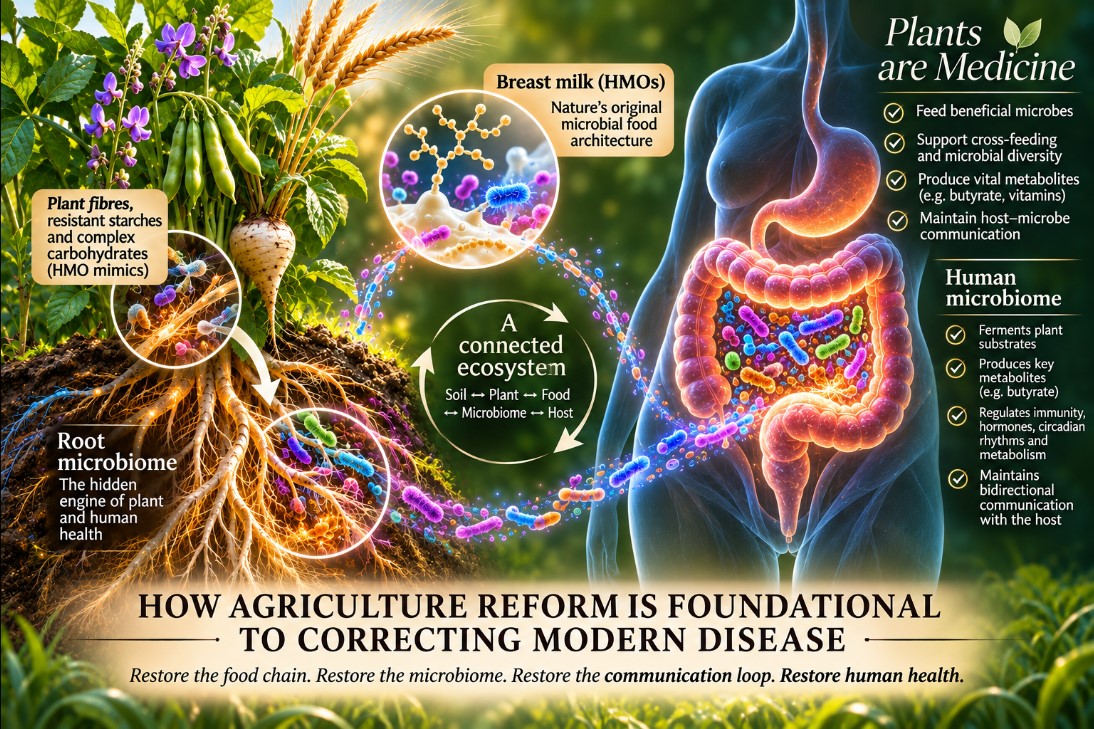
Human breast milk is extraordinary. It contains nutrients for the developing infant, immune components, antibodies, enzymes, hormones and a remarkable family of complex carbohydrates known as human milk oligosaccharides, or HMOs. More than 200 HMO structures have been identified.
The infant does not digest most HMOs directly. A substantial proportion passes through the small intestine and reaches the colon, where selected microorganisms utilise them. This is not simply feeding a baby. It is the deliberate establishment of a microbial ecosystem.
HMOs provide selective nutritional substrates that favour particular organisms, especially certain Bifidobacterium species. Different HMO structures are utilised by different organisms according to their specialised transport systems and carbohydrate-processing enzymes. Some of these organisms produce metabolites that become available to other members of the microbial community.
One organism consumes a substrate. Its metabolism produces compounds that another organism can use. That organism produces further metabolites, supporting additional microbial populations and host interactions. We are looking at an interconnected nutritional architecture. Breast milk supplies more than nutrition to the infant. It supplies selective ecological resources that help shape the microbial community.
This principle is not restricted to infant biology.
Jacobs and colleagues published a human intervention study in Scientific Reports in 2023. Thirty-two healthy adults received a complex HMO concentrate derived from pooled donor breast milk. The researchers observed dose-dependent expansion of Bifidobacterium, changes in microbial gene content, subsequent microbial succession after HMO administration stopped, changes in circulating metabolites, and increased circulating TGF-β and IL-10.
An especially revealing observation was that the complex HMO mixture produced effects that individual HMOs, or a defined mixture of the ten most abundant HMOs, did not reproduce in laboratory experiments. The less abundant components contribute to the overall ecological effect. Complexity of the substrate supply matters as much as the presence of any individual carbohydrate.
Reference: Jacobs et al. (2023), Human milk oligosaccharides modulate the intestinal microbiome of healthy adults. https://doi.org/10.1038/s41598-023-41040-5
A study published in Cell Host & Microbe in 2022 paired Bifidobacterium infantis with HMOs. The researchers demonstrated HMO-dependent engraftment in healthy adults, reaching up to 25% relative abundance of the bacterial population. The combination also increased butyrate in experimental models involving dysbiotic human microbiota.
A subsequent 2023 study examined 56 antibiotic-perturbed healthy adults. B. infantis reached up to 81% relative abundance in some participants when supplied with HMOs. The investigators also demonstrated cross-feeding with Veillonella.
These studies establish a critical point: microbial establishment is governed by the availability of the appropriate ecological substrate. The organism and its food supply cannot be considered independently.
References:
2. The plant world already contains an enormous library of microbial food
We do not need to reproduce human breast milk to apply this principle. Plants have supplied complex carbohydrates to human-associated microbial ecosystems throughout our evolutionary history. Many of these carbohydrates resist digestion in the upper gastrointestinal tract and become substrates for microbial fermentation.
They include:
| Plant-derived substrate | Common food sources | Ecological interest |
|---|---|---|
| Fructooligosaccharides (FOS) | Chicory, onions, garlic, asparagus | Selective microbial utilisation |
| Inulin | Chicory, Jerusalem artichoke, some vegetables | Fermentation and microbial succession |
| Galactooligosaccharides (GOS) | Chickpeas, lentils, beans | Bifidobacterial and other microbial feeding |
| Resistant starch | Green bananas, legumes, cooked-and-cooled starches | Cross-feeding and butyrate-producing networks |
| Pectin | Apples, citrus, carrots | Complex carbohydrate degradation |
| Xylooligosaccharides (XOS) | Grains and plant fibres | Selective fermentation |
| Arabinoxylans | Wheat bran and other cereal fibres | Microbial carbohydrate utilisation |
| Beta-glucans | Oats and barley | Fermentation and metabolic signalling |
These are not chemically identical to HMOs. That distinction is important. We are concerned with functional ecological mimicry, not with claiming that a chickpea or banana contains human breast-milk carbohydrates.
Different substrates select for different organisms and metabolic pathways. A diverse substrate supply supports a broader range of microbial functions than reliance on any single prebiotic.
This leads directly to a question that conventional nutritional advice almost never confronts with adequate seriousness.
What happens when the very foods we recommend to rebuild the microbiome are produced under agricultural conditions that introduce additional chemical exposures? What happens when the food supply remains nutritionally recognisable but its production environment has been fundamentally altered?
3. The agricultural contradiction: repair foods grown in disrupted systems
Many of the foods we recommend for microbiome health are ancient dietary staples. Pulses, wheat, bananas, onions, garlic, fruit and vegetables have been part of human diets for generations. They provide fermentable carbohydrates, plant polyphenols, minerals, vitamins and other substrates. They are not new inventions.
Modern agricultural production has changed them profoundly.
Large-scale monoculture, herbicide use, fungicide applications, pre-harvest crop treatments, post-harvest preservation and intensive production systems have altered the environmental context in which food is grown and distributed.
Consider pulses. Glyphosate has been used in certain pulse-growing systems as a pre-harvest weed-control or crop-management tool. The precise permitted uses vary by country and crop. The concern is not that every lentil or chickpea carries a harmful glyphosate residue—that would require individual exposure measurements. The concern is that agricultural chemicals introduce biological pressures that nutritional analysis alone does not capture.
A food can contain the expected fibre and carbohydrate content while its production history introduces a separate set of chemical exposures. Both must be assessed.
The shikimate pathway: a particularly important example
Glyphosate inhibits 5-enolpyruvylshikimate-3-phosphate synthase (EPSPS). This enzyme participates in the shikimate pathway, which plants and many microorganisms use to synthesise aromatic amino acids. Humans do not possess this pathway. Many bacteria do.
The absence of a particular pathway in human cells does not establish that a chemical targeting that pathway is biologically irrelevant to the human organism. Our microbial partners possess biochemical machinery that we do not.
A 2021 computational study by Leino and colleagues examined the shikimate pathway in human gut microbiome datasets. Comparing 734 paired metagenomes and metatranscriptomes, they found that the pathway was much less frequently transcriptionally active than its gene presence would suggest. Possessing a potentially sensitive pathway does not automatically establish active inhibition in the human gut. The work nevertheless demonstrated why pathway-level investigation is necessary. Microbial susceptibility cannot be determined simply by looking at total bacterial abundance.
Reference: Leino et al. (2021). https://doi.org/10.1016/j.crtox.2020.04.001
A 2021 rat study by Mesnage and colleagues used shotgun metagenomics and metabolomics to investigate glyphosate and a commercial formulation. The investigators observed accumulation of shikimate-pathway intermediates in the caecum, consistent with interference in microbial EPSPS activity. This moved beyond bacterial counts and examined metabolic consequences.
Reference: https://pubmed.ncbi.nlm.nih.gov/33502259/
A 2023 review by Walsh, Hill and Ross examined the potential effects of glyphosate on gut microbial composition and functionality. https://doi.org/10.1080/19490976.2023.2263935
A further critical review published in October 2026 examined glyphosate and glyphosate-based herbicides across mammalian gut microbiome studies. It identified recurring findings in controlled rodent experiments, including changes in microbial composition, lactobacilli, intestinal inflammation, permeability and microbial metabolism. It also made clear that human evidence remains limited and that realistic human exposure effects require better investigation.
Reference: https://doi.org/10.1002/jat.70475
This is precisely why we must investigate biological consequences rather than dismiss the question because mammals lack the targeted pathway. The microbial ecosystem has its own biochemistry, and that biochemistry forms part of our biological environment.
4. The problem is not simply bacterial death. It is ecological disorganisation
This is one of the most important distinctions in the entire field.
We must stop treating the microbiome as a bag of bacteria whose health can be determined by counting how many organisms remain. A microbial ecosystem is organised through relationships. Organisms compete, cooperate, exchange metabolites, consume one another’s metabolic products and occupy different ecological niches.
Some organisms degrade complex carbohydrates. Others consume the products of that degradation. Some produce acetate and lactate. Others use these compounds to produce butyrate. Some interact with the mucus layer. Others contribute to bile-acid transformations, vitamin synthesis and immune signalling.
The community is not a collection of independent organisms. It is a network of biological dependencies.
Consider cross-feeding
A simplified example:
Complex plant carbohydrate
↓
Primary carbohydrate utilisation by selected microbes
↓
Production of acetate, lactate and other fermentation products
↓
Secondary utilisation by neighbouring organisms
↓
Production of butyrate and other microbial metabolites
↓
Interaction with intestinal epithelial cells, immune pathways and host metabolism
This is not a universal linear pathway. Different organisms, substrates and environmental conditions produce different metabolic networks. The principle, however, is fundamental. The activity of one organism can support the existence and function of another.
If an upstream population is lost, the consequences extend beyond that population. If a metabolic pathway is disrupted, its downstream products become less available. If a cross-feeding relationship disappears, the organisms that depended on it lose their ecological advantage. If the community is repeatedly exposed to pressures that favour different organisms, its composition and functional organisation change progressively.
A microbiome can remain populated while its original ecological relationships deteriorate. That is why total bacterial abundance, or even a simple diversity score, cannot adequately describe ecosystem integrity.
The reconstruction problem
This produces a crucial set of distinctions:
- Organism presence is not functional activity.
- Functional activity is not necessarily successful cross-feeding.
- Cross-feeding is not necessarily stable ecological reconstruction.
- A temporary increase in one bacterial population is not proof that the wider ecosystem has recovered.
This is precisely why we have treated the Trio as a sentinel of broader microbial condition rather than as the entire microbiome. Akkermansia, Faecalibacterium and Roseburia are not the complete ecosystem. Their return is potentially informative because it may reflect the recovery of some of the wider conditions that support them. The target is the ecosystem, not three isolated organisms.
5. The microbiome is not just a digestive organ
Perhaps the greatest misunderstanding in modern microbiome discussion is the reduction of its function to digestion. Digestion is important, but it is only one part of a much wider biological relationship.
The microbial ecosystem participates in the transformation and availability of compounds that influence multiple host systems. These include short-chain fatty acids, secondary bile acids, tryptophan-derived metabolites, vitamin-related metabolic pathways, aromatic amino acid metabolism, immune signalling compounds, and microbial components recognised by host receptors.
These products interact with intestinal epithelial cells, immune cells, enteroendocrine signalling, peripheral metabolism and neural communication. The host also influences the microbial ecosystem through mucus production, bile secretion, immune activity, intestinal motility, oxygen availability, nutrient delivery and circadian rhythms. The relationship is reciprocal.
The circadian connection
Microbial communities exhibit daily fluctuations in composition, activity and metabolite production. Host circadian rhythms influence feeding patterns, bile-acid secretion, immune responses and intestinal physiology. In the other direction, microbial metabolites—including short-chain fatty acids, secondary bile acids and tryptophan derivatives—participate in signalling pathways that interact with host metabolic and circadian regulation.
A 2025 review by Bautista and colleagues describes this bidirectional relationship between circadian rhythms and the gut microbiome. https://doi.org/10.1007/s00253-025-13570-7
This is not a one-way digestive process. It is a dynamic communication network. The same applies to immune regulation and the gut–brain axis. Microbial metabolites and structural components interact with immune pathways, enteric neural circuits and central nervous system signalling.
Reference: Host–microbe interactions: communication in the microbiota–gut–brain axis, Current Opinion in Microbiology, 2024. https://doi.org/10.1016/j.mib.2024.102494
When microbial ecology changes, investigation must not be restricted to whether digestion has improved or worsened. We must ask what has happened to the biological communication network. Have metabolic exchanges changed? Have immune signals changed? Have bile-acid transformations changed? Have microbial rhythms changed? Have the substrates and metabolites supporting peripheral host functions changed? And are the relationships capable of returning?
This is where microbial ecology becomes central to systems biology rather than a specialist topic in gastroenterology.
6. The missing microbes: what are we using as our reference?
There is another fundamental problem with modern microbiome research. Much of our reference data comes from industrialised populations. What if those populations have already lost microbial organisms and relationships that were once common throughout human evolution?
A study published in Nature in October 2026 examined the gut microbiomes of the Tsimane horticulturalists of Bolivia and Hadza hunter-gatherers of Tanzania. The researchers identified 1,231 microbial species shared between these geographically separated populations. Approximately 60% were rare or absent in industrialised populations. Their evolutionary analyses suggested that many of these microorganisms had travelled with human populations through ancient migrations.
In other words, some microbial relationships may have accompanied humanity for tens of thousands of years, only to become uncommon or disappear in industrialised populations.
Reference: Prehistoric global migration of vanishing gut microbes with humans, Nature, 2026. https://www.nature.com/articles/s41586-026-11106-1
This raises a serious methodological question. If industrialised populations have already undergone substantial microbial change, can they serve as the sole reference for defining a healthy human microbiome? We may be comparing different degrees of ecological disruption rather than comparing an altered ecosystem with its original biological condition.
This is not an argument that traditional populations represent a perfect or universal health baseline. They differ in genetics, environment, diet, infections, lifestyle and many other factors. Their microbial diversity nevertheless provides valuable evidence of what has been lost from many industrialised populations, and it strengthens the case for treating microbial biodiversity as something worth preserving.
7. The agricultural problem: we are feeding the biome from a changed ecological system
Bring these findings together.
We know that complex carbohydrates can selectively influence microbial populations. We know that microbial organisms depend on specialised metabolic machinery. We know that cross-feeding relationships support the production of important metabolites. We know that microbial products participate in host signalling. We know that some microbial species historically associated with humans are now rare or absent in industrialised populations. And we have experimental evidence that certain agricultural chemicals can interfere with microbial pathways under defined conditions.
Yet our response to microbiome disruption almost always begins downstream. We recommend more fibre. We recommend prebiotics. We recommend probiotics. We investigate faecal microbiota transplantation. We manufacture isolated microbial metabolites and nutritional supplements.
Some of these interventions can be useful. Some have demonstrated clinical benefits. We must nevertheless ask a more fundamental question.
What happens when the agricultural system supplying the substrates and chemical exposures remains unchanged? We may be improving the recipient environment while leaving the upstream ecological conditions that influence microbial health largely unexamined.
This is not an argument against plant foods. It is an argument for examining how plant foods are produced.
A lentil is not inherently harmful because glyphosate is used in some pulse-production systems. An apple is not inherently harmful because some citrus and fruit supply chains use post-harvest fungicides. Actual chemical exposure depends on the crop, production system, treatment, residue, handling and consumption. The nutritional value of a food should never be the only measure of its biological quality.
We need to examine:
- Nutritional composition.
- Fermentable carbohydrate and glycan composition.
- Agricultural chemical residues.
- Soil biological condition.
- Crop genetic diversity.
- Post-harvest treatments.
- Effects on microbial metabolic function.
- Effects on cross-feeding and community reconstruction.
A food system must be evaluated as a biological production system, not merely a calorie and nutrient delivery system.
8. Why downstream repair may never be enough
This brings us to the central argument of this article.
The microbiome is not an optional accessory to human biology. The host and its microbial ecosystem participate in bidirectional communication. The host provides the environment in which microbes survive. Microbial populations transform substrates, produce metabolites and participate in biological signalling that feeds back into the host. This creates a coupled system.
When the ecosystem loses important organisms, functions or relationships, the host may lose some of the biological contributions those relationships normally provide. The host can compensate. It can use alternative pathways. It can obtain certain nutrients directly. It can manufacture compounds that would otherwise be supplied through microbial metabolism. Medicine can replace particular products.
Replacement is not reconstruction.
A manufactured vitamin is not the same thing as restoring the entire ecological and metabolic environment that normally supports its availability and utilisation. A probiotic is not automatically a reconstructed microbial community. A prebiotic does not guarantee that the organisms capable of using it are present. A rise in butyrate does not prove that the wider microbial network has recovered. A successful FMT does not automatically establish durable restoration of every lost ecological relationship.
These distinctions are essential.
The bidirectional dependency problem
Our working model can be expressed as follows:
Agricultural ecology → Food composition and exposure → Microbial ecological integrity → Cross-feeding and metabolic output → Host communication → Biological function.
This is not a one-way chain. Host biology feeds back into the microbial environment through mucus, bile, immune signalling, motility, nutrient availability and circadian rhythms. The system is reciprocal. A disturbance at one level can propagate through the network.
If an altered microbial ecosystem becomes self-maintaining, restoring an isolated downstream component may not be sufficient to reverse the wider state.
This is where our proposed frameworks become relevant. Secondary Biological State (SBS) describes the proposed altered configuration of biological functioning that can emerge following disturbance. Regulatory Lock describes the proposed persistence of an altered configuration when feedback mechanisms and compensatory processes maintain it beyond the original disturbance. These are working framework terms, not established clinical diagnoses. They offer a useful way to investigate what happens when a system adapts to an altered environment and subsequently struggles to return to its previous organisation.
The question is no longer simply whether a particular nutrient or organism is deficient. It becomes:
- What has changed in the network?
- Which functions have been lost?
- Which compensatory pathways have become dominant?
- What is the correction throughput?
- What remains necessary for reconstruction?
- Can the original relationships be restored?
This is the difference between treating an individual output and rebuilding the biological system that produces it.
9. Agriculture must become part of microbiome medicine
If we accept that food supplies the substrates and exposures entering the microbial ecosystem, agricultural production cannot remain outside the discussion. We need to rethink what constitutes a healthy food-production system.
This does not mean abandoning modern science or returning indiscriminately to historical farming practices. It means using modern scientific understanding to redesign agricultural systems around biological compatibility.
Priorities must include:
Soil biodiversity — Preserving living soil ecosystems, microbial diversity, organic matter and biological nutrient cycling.
Seed diversity — Protecting traditional and locally adapted varieties, including heirloom seeds, and reducing unnecessary dependence on narrow genetic uniformity.
Chemical exposure reduction — Investigating integrated pest management, biological controls, crop rotation and production methods that reduce unnecessary chemical inputs.
Food quality — Measuring not only calories, protein, fibre and micronutrients, but also fermentable carbohydrate profiles, phytochemicals and relevant chemical residues.
Agricultural transparency — Improving traceability of herbicide, pesticide, fungicide and post-harvest treatments.
Longitudinal biological testing — Examining how foods produced under different agricultural systems affect microbial composition, gene expression, metabolite production, cross-feeding and host responses.
Organic certification alone cannot answer these questions. Neither can the word regenerative. We need actual measurements.
A research experiment worth conducting
Take the same crop variety and grow it under different documented production systems. Measure soil microbial diversity and activity, crop nutritional and glycan composition, glyphosate, AMPA and other relevant pesticide residues, post-harvest chemical exposure, microbial carbohydrate-utilisation pathways, metabolite production, cross-feeding relationships, and host-relevant barrier and immune responses in appropriate experimental models. Then investigate whether the differences in production history translate into measurable differences in microbial function.
This would move the agricultural argument beyond general concern and into testable biology.
10. The next frontier: ecological nutrition
We began this investigation by asking whether the food architecture of breast milk might offer clues to microbial reconstruction. It led us to plant-derived oligosaccharides, resistant starch, pectin, cross-feeding and the selective nutritional requirements of microbial communities.
The investigation has taken us somewhere much larger.
We cannot simply identify a carbohydrate, manufacture it and assume that the microbiome will recover. We must understand the organisms capable of using it, the metabolic relationships that follow, the host environment that supports those relationships, and the agricultural system that supplies the substrate.
This defines a new research direction:
Ecological nutrition — understanding food not merely as nourishment for the human body, but as the biological resource system that sustains the microbial ecosystem through which much of host biology is regulated.
It is a different way of approaching nutrition. Instead of asking only what nutrients the human body requires, we also ask what resources the microbial ecosystem requires to maintain its functions and relationships. Instead of asking which bacterium we should introduce, we ask what ecological conditions permit the desired community to establish and persist. Instead of measuring whether an organism is present, we investigate whether the metabolic relationships that give it biological relevance have returned. And instead of treating agriculture as a separate industry, we recognise it as an upstream part of the human biological environment.
Conclusion: we cannot rebuild the roots while continuing to undermine them
The human microbiome is not simply a collection of bacteria that helps digest food. It is a complex microbial ecosystem involved in nutrient transformation, metabolite production, immune regulation, mucosal integrity, metabolic signalling and communication with the nervous system. Its relationship with the host is bidirectional. Its stability depends on organisms, substrates, environmental conditions and metabolic relationships.
Breast milk demonstrates how sophisticated natural nutritional architecture can be in shaping a microbial ecosystem. Plant foods provide a vast range of complex carbohydrates that can support microbial fermentation and cross-feeding. The modern agricultural system introduces a further, unavoidable question: are we preserving the ecological and chemical conditions required for those relationships to function?
We have increasingly sophisticated tools to replace individual nutrients, introduce selected microorganisms and manipulate microbial metabolites. Those interventions cannot automatically recreate a lost ecological network.
The objective should not be to manufacture an endless supply of substitutes for biological functions that a healthy ecosystem can help provide. It should be to restore the conditions under which those functions can operate.
This is why agricultural reform belongs at the centre of the microbiome discussion. Not as an environmental side issue. Not as a lifestyle preference. As a biological research priority.
We cannot sustainably maintain host biology by treating the microbial ecosystem as an optional accessory. The host and its microbiome are coupled systems, and the integrity of their bidirectional communication depends on the ecological conditions that sustain both.
Those conditions begin long before food reaches the plate. They begin in the soil.
We cannot keep trying to repair the leaves while ignoring the roots.
Research notes: what is established, what is emerging, and what we propose
To preserve the scientific integrity of this work, the following distinctions matter.
| Research area | Current position |
|---|---|
| HMOs selectively shape microbial communities | Demonstrated in infant biology and adult intervention studies |
| HMO-supported microbial engraftment and cross-feeding | Demonstrated in human and experimental studies |
| Plant-derived fermentable carbohydrates support microbial metabolism | Well established, with substrate- and organism-specific effects |
| Glyphosate can disrupt microbial shikimate-pathway activity | Supported by mechanistic and controlled animal evidence |
| Agricultural pesticide exposure changes human gut ecology | Plausible, with emerging but incomplete human evidence |
| Microbiome participates in immune, metabolic, neural and circadian communication | Supported by extensive mechanistic and clinical research |
| Industrialisation is associated with loss of some historically prevalent microbial species | Supported by comparative population research |
| Agricultural disruption is a major upstream contributor to human microbial ecosystem deterioration | Important integrative hypothesis requiring direct testing |
| Agricultural reconstruction is necessary for durable population-wide microbiome recovery | Proposed systems-level thesis, not yet demonstrated as a universal requirement |
The distinction between evidence and synthesis is deliberate. The research does not need every part of the proposed model to have been demonstrated in one experiment for the connections to deserve investigation. The objective is to identify the relationships, test their predictions and establish which parts of the proposed architecture hold.
Selected references
- Jacobs JP et al. (2023). Human milk oligosaccharides modulate the intestinal microbiome of healthy adults. Scientific Reports. https://doi.org/10.1038/s41598-023-41040-5
- Dosing a synbiotic of human milk oligosaccharides and B. infantis leads to reversible engraftment in healthy adult microbiomes without antibiotics. (2022). Cell Host & Microbe. https://doi.org/10.1016/j.chom.2022.04.001
- Precision modulation of dysbiotic adult microbiomes with a human-milk-derived synbiotic reshapes gut microbial composition and metabolites. (2023). Cell Host & Microbe. https://doi.org/10.1016/j.chom.2023.08.004
- Leino L et al. (2021). Computational modelling provides insight into the effects of glyphosate on the shikimate pathway in the human gut microbiome. https://doi.org/10.1016/j.crtox.2020.04.001
- Mesnage R et al. (2021). Use of shotgun metagenomics and metabolomics to evaluate the impact of glyphosate or Roundup on the gut microbiota and serum metabolome of rats. https://pubmed.ncbi.nlm.nih.gov/33502259/
- Walsh L, Hill C, Ross RP. (2023). Impact of glyphosate on the composition and functionality of the gut microbiome. Gut Microbes. https://doi.org/10.1080/19490976.2023.2263935
- Mesnage R. (2026). Effects of Glyphosate and Glyphosate-Based Herbicides on the Mammalian Gut Microbiome: A Critical Review. Journal of Applied Toxicology. https://doi.org/10.1002/jat.70475
- Bautista J et al. (2025). Bidirectional interactions between circadian rhythms and the gut microbiome. Applied Microbiology and Biotechnology. https://doi.org/10.1007/s00253-025-13570-7
- Host–microbe interactions: communication in the microbiota–gut–brain axis. (2024). Current Opinion in Microbiology. https://doi.org/10.1016/j.mib.2024.102494
- Prehistoric global migration of vanishing gut microbes with humans. (2026). Nature. https://www.nature.com/articles/s41586-026-11106-1
- Pesticide Residues, Gut Microbiota, and Gastrointestinal Outcomes: A Scoping Review of Human Evidence. (2026). https://pubmed.ncbi.nlm.nih.gov/42634103/
- Impact of Pesticide Use on Gut Microbiota and Health: A Systematic Review of Findings in Both Humans and Animal Models. (2026). https://pmc.ncbi.nlm.nih.gov/articles/PMC13010730/
Research position: This article presents an integrative research hypothesis linking ecological nutrition, agricultural production, microbial metabolic relationships and host biological communication. It does not claim that one pesticide, food or agricultural practice explains all chronic disease, nor that agricultural reform alone is a proven cure. Its central proposition is that sustainable microbiome reconstruction requires serious attention to the upstream ecological conditions that support the human–microbial system.