The microbial to glymphatic loop
The microbial to glymphatic loop
The surprising discoveries connecting our microbial world, biological clocks, the vagus nerve and the brain’s clearance system
An exploration of the research that changed how we think about the relationship between the microbiome and the human body.
There is a particular kind of discovery that happens when you have been investigating a problem for long enough. You are no longer looking for another fact. You are looking for the missing connection that makes several facts suddenly make sense together.
Sometimes that connection comes from an unexpected place.
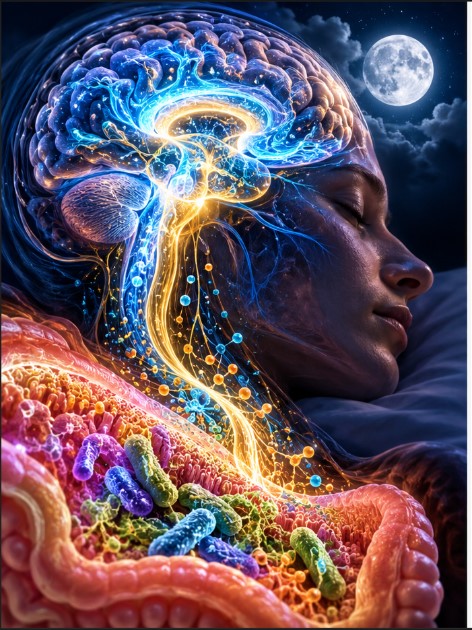
In our exploration of the relationship between microbial communities, biological rhythms and human physiology, we kept encountering observations that seemed to belong to different scientific worlds. Gut bacteria changed their activity across the day. Microbial metabolites influenced host cells. The intestine possessed its own biological clock. The vagus nerve carried information between the gut and the brain. Sleep altered the movement of fluid through brain tissue. The brain had a clearance system whose activity was linked to sleep and the body’s rhythms.
Each was fascinating in its own right.
But a question began to emerge: What if these weren’t simply separate processes happening alongside one another? What if they were parts of a much more interactive system?
The journey took an unexpected turn when we began examining the glymphatic system. Until then, we had been following the connections between the microbial environment, host signalling and biological regulation. The brain’s clearance machinery introduced something we had not fully accounted for: a system whose activity was strongly linked to the timing and quality of sleep, and which could potentially connect neural regulation with the body’s wider rhythms.
That was the moment the puzzle changed.
The excitement wasn’t merely that we had found another component. It was that the component forced us to reconsider the shape of the whole system. A pathway that appeared to travel from the gut towards the brain might not end there at all.
To understand why that mattered, we need to follow the research clues themselves.
1. The first surprise: our microbes keep time
We tend to imagine the gut microbiome as a collection of organisms living in a relatively stable environment. Its membership may change with diet, illness, medication and age, but it is easy to overlook the possibility that the community also changes its behaviour according to the time of day.
That is precisely what researchers began investigating.
Discovery 1 — The microbial community oscillates with the day
In a landmark 2014 Cell study, Thaiss and colleagues investigated daily rhythms in the gut microbiota. Their work showed that microbial composition and function oscillated over the day, with feeding rhythms and the host’s biological clock playing important roles. Experiments in mice showed that disrupting normal daily timing could disturb microbial oscillations.
Think about what that means.
The gut is not simply a habitat in which microbes perform their functions at a constant rate. The timing of food arriving, the changing physiological environment and the host’s daily rhythms help shape what the microbial community does.
The host is influencing the biome before we even begin considering what the biome does in return.
And that raises an intriguing question: if the host’s rhythms help organise microbial activity, what happens when microbial activity begins influencing the host’s own biological clocks?
Discovery 2 — Microbial products can influence the host’s clock
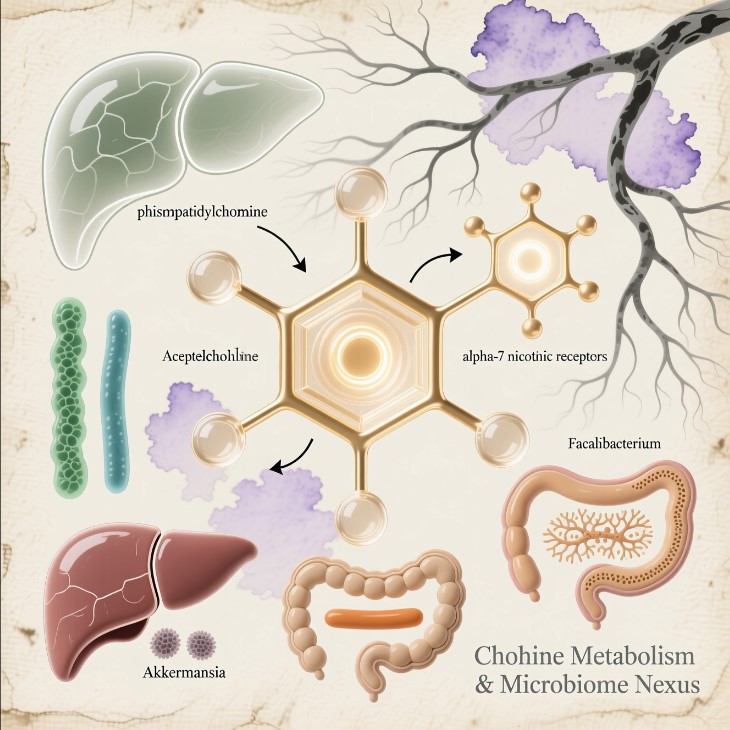
Short-chain fatty acids, including acetate, propionate and butyrate, are produced when microbes ferment suitable substrates. They are often discussed in terms of intestinal health, epithelial function and immune regulation.
But their influence is not necessarily confined to those familiar roles.
Research published in Gastroenterology in 2022 investigated how short-chain fatty acids influence circadian rhythms in intestinal epithelial cells, including through mechanisms involving histone deacetylases.
2022 study — Short-chain fatty acids and intestinal epithelial circadian rhythms
This adds a remarkable dimension to the relationship. Microbial metabolism produces chemical compounds that can influence the behaviour of host cells, including processes involved in biological timing.
The clock shapes the microbial environment. Microbial products can, in turn, influence the host’s timing machinery.
That is no longer a simple story of bacteria producing something beneficial for the intestine. It is a potential feedback relationship between microbial metabolism and host rhythmic regulation.
Discovery 3 — The intestinal clock can reshape the microbial environment
A 2022 Nature Communications study investigated the consequences of disrupting the circadian clock in intestinal epithelial cells. In mice, intestinal clock disruption altered aspects of microbial rhythmicity and changed patterns involving short-chain fatty acids and bile acids.
2022 study — Intestinal epithelial clock disruption and microbial rhythmicity
Notice the direction of the relationship.
Microbial products can influence host cells, but host clock function can also influence the microbial ecosystem and its metabolic environment.
The two sides are not independent. They help shape one another.
This is one of the first places where the larger picture begins to emerge from the individual studies: a biological system in which timing, metabolism and microbial ecology continually interact.
2. The chemical conversation has more than one language
Once we began looking at microbial metabolites as signals rather than merely products, another set of observations became more interesting.
Short-chain fatty acids are only part of the story. Bile acids, too, are modified by the gut microbiota and participate in signalling networks involving the host.
Discovery 4 — Bile acids are not just digestive chemicals
Bile acids help the body handle fats, but their functions extend beyond digestion. They can act as signalling molecules through receptors and other regulatory pathways. Meanwhile, gut microbes can transform the bile acids that reach the intestine, changing the chemical environment to which the host is exposed.
Research on the intestinal clock, microbial metabolism and bile-acid signalling therefore points towards a shared regulatory space in which the host’s daily rhythms and microbial activity can affect one another.
The human timing evidence is particularly intriguing. A study of eight volunteers sampled repeatedly over 24 hours found daily variation in markers of bile-acid synthesis and cholesterol synthesis.
Human study — Daily rhythms in bile-acid and cholesterol synthesis
And in 2026, research on lithocholic acid investigated its influence on clock-gene timing in human colonic cells and mouse intestine.
2026 study — Lithocholic acid and circadian clock timing
Taken together, these observations make the boundary between host metabolism and microbial ecology particularly interesting. The host supplies bile acids; microbes transform them; the resulting chemical environment can influence host signalling.
We should not assume that every part of this exchange has been demonstrated to form one continuous circadian feedback loop. But the individual connections give us a concrete reason to investigate one.
The intestinal environment is not merely receiving the consequences of the body’s metabolism. It is participating in chemical exchanges that can return information to the host.
3. Then comes the vagus nerve
The gut does not communicate with the brain through one route alone. Immune signals, hormones, microbial metabolites and neural pathways all contribute to communication between the intestine and the central nervous system.
The vagus nerve is especially interesting because it provides a major route of communication between visceral organs and the brain.
Discovery 5 — The gut–brain relationship is a network, not a single pathway
Research into microbiota–gut–brain communication has explored how microbial communities can influence neural, immune and behavioural processes, and how stress physiology and the nervous system can alter the intestinal environment.
A foundational review by Cryan and O’Mahony examined the relationship between gut microbiota, the brain and behaviour.
Cryan and O’Mahony, 2011 — The microbiome–gut–brain axis
The important point is not that every microbial signal travels through the vagus nerve. It doesn’t. Nor does the broader literature establish that short-chain fatty acids necessarily travel through a single, uninterrupted route to control brain clearance.
The interesting point is that the gut and brain have multiple channels of communication, with neural signalling forming one part of a much larger exchange.
This matters when considering biological timing. The nervous system participates in the regulation of sleep, autonomic activity, digestion and other rhythmic functions. The gut is also exposed to changing neural and hormonal conditions across the day.
So we have another two-way relationship: the gut can influence neural regulation, while neural and autonomic signals help determine the physiological conditions experienced by the gut.
But there was still a missing piece in our exploration.
We had microbial activity, metabolic signals, biological clocks and a neural communication route. What about the system responsible for clearing material from the brain’s own tissue environment?
4. The discovery that changed the shape of the puzzle
Discovery 6 — The brain has a fluid-clearance system linked to sleep
The glymphatic system describes pathways through which cerebrospinal fluid exchanges with fluid in brain tissue, helping facilitate the movement and clearance of substances from the brain’s interstitial environment.
Research led by Maiken Nedergaard and colleagues helped bring this system to wider attention, including studies investigating how sleep and wakefulness affect the movement of fluid through the brain.
This was an important shift in how researchers thought about sleep. Sleep was not simply a period in which the brain switched off from the demands of the day. It was a physiological state in which important processes changed, including the dynamics of fluid movement and clearance.
The glymphatic system is still an active area of investigation. Its precise operation in humans, the relative importance of different routes and the contribution of particular physiological mechanisms remain subjects of research. But the connection between sleep state and brain-fluid dynamics provided a compelling new line of inquiry.
Discovery 7 — The relationship between sleep and clearance is dynamically regulated
In 2025, Hauglund and colleagues published research in Cell investigating the relationship between norepinephrine, cerebral blood volume, cerebrospinal-fluid dynamics and glymphatic clearance during non-rapid-eye-movement sleep.
Their experiments found coordinated changes in these signals, and the researchers showed that manipulating vascular oscillations could affect cerebrospinal-fluid inflow.
Hauglund et al., Cell, 2025 — Sleep, norepinephrine, vascular dynamics and glymphatic clearance
This is an especially fascinating finding because it places clearance within a dynamic physiological context.
The movement of fluid is not simply a matter of opening a drain. It is associated with changing neural activity, blood-volume dynamics and the physiological state of sleep.
That makes sleep timing and quality relevant to more than the number of hours spent in bed. The organisation of sleep, the transitions between states and the physiological events accompanying those states may all matter.
Discovery 8 — Glymphatic activity and lymphatic drainage do not necessarily follow the same daily pattern
A 2020 Nature Communications study by Hablitz and colleagues investigated daily rhythms in glymphatic influx and clearance in mice, alongside cerebrospinal-fluid drainage towards lymphatic structures.
The researchers reported that glymphatic influx and clearance varied across the day, with higher activity during the animals’ rest phase under the conditions studied. Cerebrospinal-fluid drainage towards lymph nodes showed a different daily pattern.
There is a subtle but important point here. Even within what we might casually call the brain’s clearance system, different processes need not peak together.
Fluid movement within the brain and drainage towards lymphatic structures are related, but they are not necessarily identical processes with identical timing.
That observation opens a wider question about the coordination of clearance across tissues and compartments. The body contains multiple fluid and transport systems, each operating within its own local environment while also being influenced by broader physiological conditions.
It would be premature to conclude from these findings that the glymphatic system directly controls gut microbial rhythms. The studies do not establish that connection. What they do establish is that clearance itself has timing and regulatory features worth investigating alongside the body’s other rhythmic systems.
And this was where the original puzzle changed for us.
5. The moment the loop became more interesting than the chain
At this point, we could draw a plausible forward sequence:
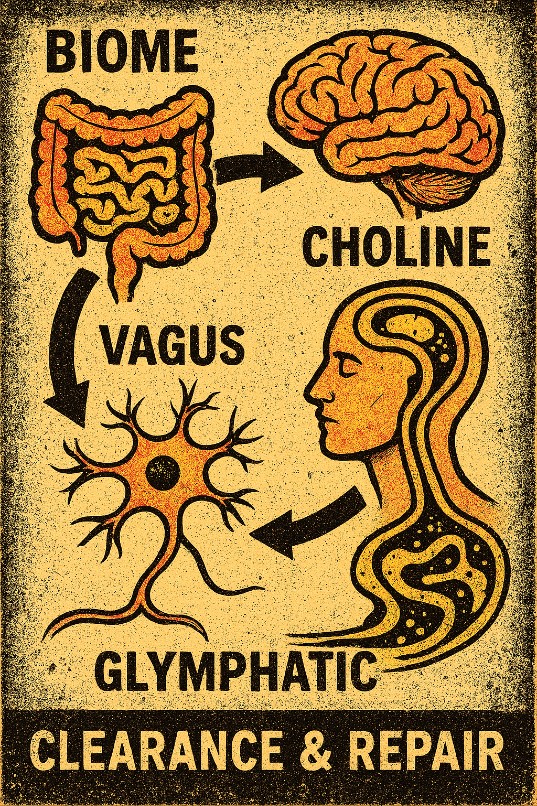
Microbial activity produces metabolites. Those metabolites influence host cells and signalling pathways. Gut–brain communication provides routes through which intestinal conditions can influence neural regulation. Neural activity and sleep state are associated with changes in brain-fluid dynamics and clearance.
But if we stopped there, we would be making the same mistake that often happens when complex biology is simplified into a pathway diagram.
We would be treating the brain as the destination.
The body does not work that way.
The nervous system influences digestion, intestinal movement, secretions, immune regulation and the physiological conditions under which microbes live. Circadian systems influence feeding, hormone release, metabolism and the timing of many host processes. Bile acids and other host-derived compounds enter the intestinal environment, where microbial communities can transform them. Those transformations can then change the signals and metabolites encountered by the host.
The microbial environment is shaped by the body, and the body is influenced by the microbial environment.
Meanwhile, the brain’s clearance processes are themselves linked to sleep and physiological rhythms. Those rhythms exist within the same organism whose autonomic, endocrine, immune and metabolic systems are communicating with the gut.
This does not mean that every component directly controls every other component. It means that the biological relationships are reciprocal, overlapping and context-dependent.
The important shift was from asking where a signal travels to asking how the conditions on both sides continually influence one another.
The glymphatic system had not supplied a proven final link connecting brain clearance back to the gut microbiome. It had revealed why a strictly linear picture was inadequate as a working model of the wider physiology.
That distinction matters. It preserves the excitement of the discovery without pretending that the entire loop has already been demonstrated experimentally.
6. The return journey: from brain and body back to the biome
The next part of the investigation becomes particularly interesting when we look at the intestinal environment again.
The gut microbiome is influenced by food, transit time, bile acids, mucus, immune activity, oxygen availability, host secretions and the daily timing of physiological processes. These conditions are not static.
The microbiome also contains organisms that depend on, compete with and sometimes support one another through shared metabolic networks. One organism’s by-product may become another organism’s resource. Changes in one population can alter the local environment for others.
That means the state of the microbial community depends not only on which organisms are present, but also on what they are doing, what resources are available and what conditions surround them.
Circadian timing adds another dimension. If feeding, intestinal physiology and microbial activity change across the day, then the relationships among organisms may also change with time. The same community may not perform the same functions at the same rate throughout a 24-hour cycle.
This is why the return leg matters so much.
A host signal can change the conditions experienced by the biome. The biome can respond by changing its activity and metabolic output. Those outputs can influence the host in turn, changing the environment in which the next round of microbial activity takes place.
The result is not necessarily a perfectly synchronised loop, nor a system that always returns to its original state. Feedback can stabilise a system, amplify a disturbance or produce different outcomes depending on timing and context.
That is a much more interesting biological problem than simply asking whether a particular bacterium is beneficial or harmful.
It asks how the entire relationship behaves.
7. The bigger discovery may be how the pieces change one another
One of the most revealing aspects of this research journey is that the evidence comes from different fields.
Chronobiology studies the timing of biological processes. Microbiome research investigates microbial communities and their metabolites. Neuroscience examines neural communication and sleep. Glymphatic research investigates brain-fluid movement and clearance. Immunology explores signalling between tissues and immune cells. Metabolic research examines compounds such as bile acids and short-chain fatty acids.
Each field has its own questions, methods and vocabulary.
Yet several recurring themes appear across them: rhythms, feedback, chemical signalling, changing local environments, host–microbe interactions and the regulation of physiological states.
The existence of these parallels does not prove that all the systems form one unified mechanism. It does, however, give us a reason to investigate how their timing and feedback relationships might intersect.
A microbial community can be influenced by its host. Its metabolic output can influence host physiology. Neural and endocrine systems can alter the environment of the gut. Sleep and circadian state can influence processes associated with brain clearance. The intestinal ecosystem can then respond to the changing conditions created by the host.
The same organism is participating in all these processes. They do not happen in separate bodies simply because separate scientific disciplines study them.
That is the wonder here: the possibility that the connections between these systems may be as important as the systems themselves.
8. And what might this mean for neurodevelopment and disease?
This was one of the reasons the glymphatic discovery generated so much excitement in our original investigation.
If microbial ecology, metabolic signalling, autonomic regulation, circadian timing and brain clearance interact, could disturbances in these relationships contribute to different patterns of biological dysfunction?
Could developmental stage influence how a disturbance is expressed? Could the same broad regulatory systems behave differently in infancy, childhood, adulthood and ageing? Could differences in timing, resilience or the ability to recover from a disturbance help explain why apparently related physiological problems produce very different outcomes?
These are important questions, but they are not yet answered by the studies collected here.
Autism, ADHD, autoimmune disease, Long COVID and neurodegenerative disorders are distinct conditions with complex and differing causes. The evidence reviewed here does not establish a single sequence linking them, nor does it demonstrate that glymphatic dysfunction causes neurodevelopmental divergence.
What it does provide is a set of research directions worth exploring: microbial and host rhythms, metabolite signalling, neural communication, sleep-dependent physiology and the regulation of biological clearance.
The potential value lies in investigating whether relationships among these systems help explain aspects of health and disease that cannot be understood by studying each component in isolation.
That is a research question, not a diagnosis—and it is a much more interesting question than assuming that the answer must lie in one organism, one pathway or one organ.
9. The discovery is still unfolding
Looking back at the sequence of findings, the original excitement becomes easier to understand.
First, the microbial community turned out to have daily rhythms. Then came evidence that microbial products could influence host clocks, while the host’s own clock could reshape the microbial environment. Gut–brain research added neural and other routes of communication. Glymphatic research showed that brain-fluid dynamics and clearance are associated with sleep state and physiological rhythms. Bile-acid research added another layer of reciprocal chemical signalling between host and microbiome.
Each finding opened another question.
And each question made the original, one-way picture less satisfying.
The studies do not yet demonstrate one complete, experimentally validated circuit linking microbial rhythms, short-chain fatty acids, vagal signalling, hypothalamic regulation, glymphatic clearance and the return of host signals to the microbial ecosystem. That remains a hypothesis to investigate. The individual mechanisms also vary in how well they have been established in humans, animals and laboratory models.
But there is a meaningful difference between claiming that the entire circuit has been proven and recognising that its component relationships are scientifically plausible and worth testing together.
The former would be premature. The latter is exactly what makes this field of inquiry exciting.
The body is not a collection of independent machines that happen to share an address. Its organs, tissues, microbial communities and regulatory systems exist in continuous exchange. Their interactions change with physiological state, environmental conditions and time of day.
And the microbiome is not standing outside that exchange, waiting to be added to the picture.
It is part of the picture.
Perhaps the most productive next step is not to declare that we have solved the loop, but to ask what experiments would reveal its structure: which signals travel along which routes, which effects depend on circadian timing, which feedback relationships are necessary, and what happens when one connection is disrupted while the others remain intact.
That is where the real discovery lies—not in forcing every observation into a single explanation, but in recognising that the connections themselves may deserve to become the subject of investigation.
Because sometimes the missing piece does more than complete the puzzle.
Sometimes it makes you realise that you have been looking at the wrong shape of puzzle all along.