The Boundary–Identity–Clearance Framework – BIC
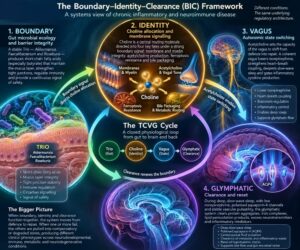
The Boundary–Identity–Clearance Framework
A systems view of chronic inflammatory and neuroimmune disease
Chronic illness is usually organised by organ or label: autism is developmental, colitis is gastrointestinal, long COVID is post-viral, Alzheimer’s is neurodegenerative. The resulting literature is vast and fragmented. What if many of these conditions are not separate diseases but different expressions of the same underlying regulatory failure?
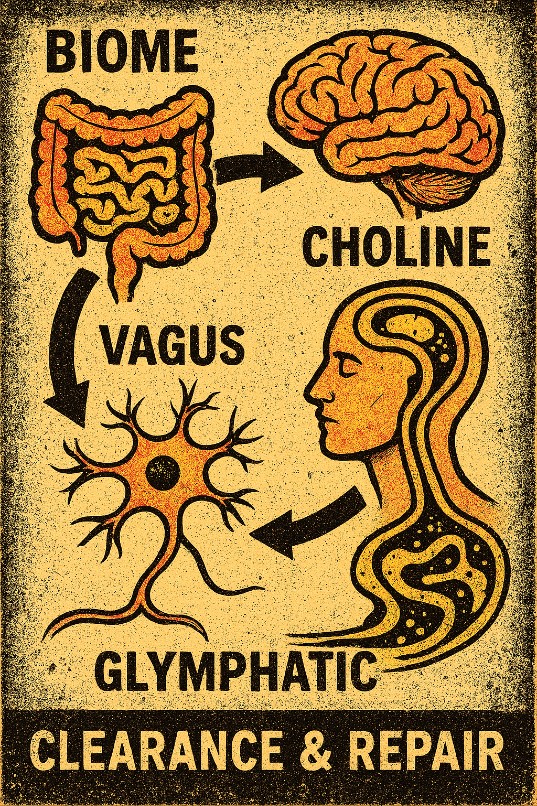
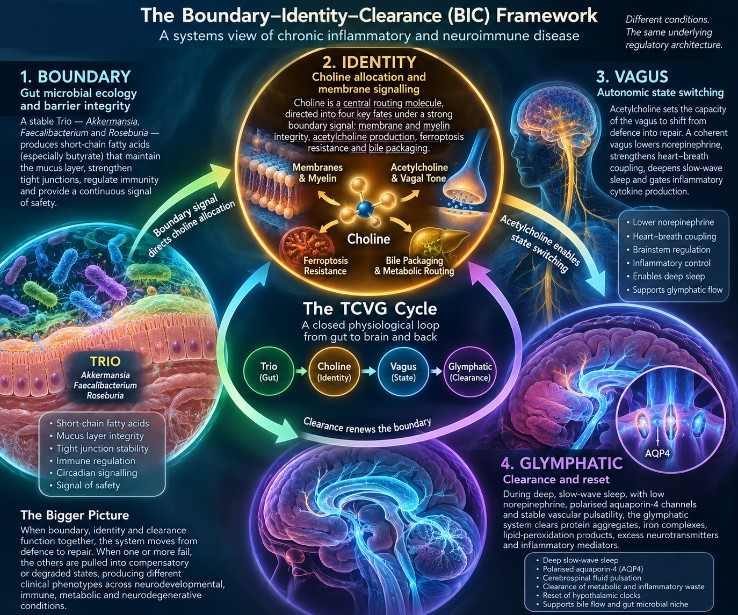
The Boundary–Identity–Clearance (BIC) model proposes that chronic disease emerges when three fundamental biological functions fail to resolve: the integrity of biological boundaries, the coherence of identity signalling, and the completion of clearance. These functions are linked by a closed physiological loop — the Trio–Choline–Vagus–Glymphatic (TCVG) cycle — that runs from gut microbial ecology through membrane and neurotransmitter chemistry, autonomic state, and sleep-dependent brain clearance, then back again.
The claim is not that every condition shares one molecular cause. It is that the same regulatory architecture, when disrupted at different nodes and different developmental stages, produces recognisably different clinical phenotypes. Treating the labels in isolation may therefore miss the system that generates them.
The Healthy Loop
In a coherent state the sequence runs as follows.
Trio → boundary signal.
Three microbial taxa — Akkermansia, Faecalibacterium and Roseburia — function less as isolated “good bacteria” and more as a distributed boundary organ. Their short-chain fatty acids, especially butyrate, supply energy to colonocytes, stabilise tight-junction proteins, shape the mucus layer, modulate histone deacetylases, promote regulatory T-cell activity, and entrain local circadian clocks. When this signal is present and rhythmic, the organism receives a continuous message that the external environment is sufficiently stable for investment in long-term structure rather than emergency defence.
Choline → identity routing.
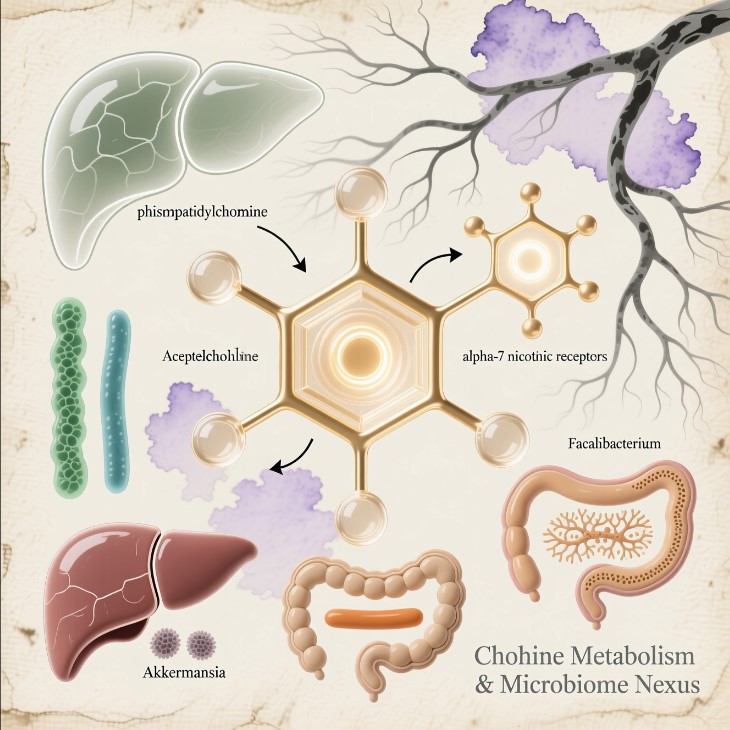
Choline is treated here not merely as a nutrient but as a central routing molecule. Under a strong Trio signal it is directed into four fates: phosphatidylcholine for membrane and myelin integrity; acetylcholine for vagal tone and the cholinergic anti-inflammatory pathway; membrane composition that resists ferroptosis; and bile packaging that maintains metabolic traffic and further shapes the microbial niche. When the upstream boundary signal collapses, choline is diverted into crisis patching. Structural clarity, signalling capacity and ferroptosis resistance all suffer.
Vagus → state switching.
Acetylcholine availability sets the capacity of the vagus to shift the organism from defence into repair. A coherent vagus lowers norepinephrine enough for glymphatic inflow, strengthens heart–breath coupling that drives cerebrospinal-fluid pulsation, deepens slow-wave sleep, and gates inflammatory cytokine production. Without adequate acetylcholine and upstream safety signalling, the system remains tilted toward vigilance.
Glymphatic → clearance and reset.
Only under low norepinephrine, deep slow-wave sleep, polarised aquaporin-4 channels and stable vascular pulsatility does the glymphatic system fully engage. It clears protein aggregates, iron complexes, lipid-peroxidation products, excess neurotransmitters and inflammatory mediators. Successful clearance reduces systemic inflammatory load, stabilises hypothalamic clocks, normalises bile flow and recreates conditions favourable to the Trio niche. The loop closes.
The architecture is circular and timed. Clearance renews the boundary; the boundary renews the signal that permits the next cycle of clearance. When any node loses integrity, the others are pulled into compensatory or degraded states.
Boundary–Identity–Clearance as State Description
BIC is the status panel for this machinery.
- Boundary (B) concerns mucus integrity, epithelial tightness, microbial ecological stability and the quality of the first signal the organism receives about safety.
- Identity (I) concerns how choline is allocated, the resulting membrane composition, neurotransmitter availability, ferroptosis resistance and metabolic routing.
- Clearance (C) concerns the capacity to complete inflammatory, metabolic and neurochemical resolution, especially during restorative sleep.
A terrain can be described as a vector (for example B2–I2–C1). Different vectors map onto different clinical presentations without requiring that the presentations be unrelated diseases. Early, severe boundary collapse during developmental windows produces one set of outcomes; later, partial identity or clearance failure produces others. The same loop, different fracture points and timing.
Failure Modes
The loop breaks in a limited number of places.
Boundary-first failure.
Early disruption of the Trio niche (antibiotics, birth mode, feeding patterns, environmental pressures) collapses SCFA signalling. Choline transporters and PEMT activity are altered, membranes and myelin form under noise, vagal maturation is incomplete, and glymphatic cycles never fully stabilise. The resulting terrain is often labelled neurodevelopmental.
Identity-first failure.
Choline is present but misrouted under metabolic or inflammatory load. Phosphatidylcholine and acetylcholine become intermittent, ferroptosis risk rises, bile becomes erratic. Attention, autonomic stability and membrane resilience fluctuate. This pattern appears in ADHD-like states, anxiety spectra, functional gut disorders and certain post-viral presentations.
Signal-first failure.
Even when boundary and choline capacity are partially intact, the vagus may remain locked in defence — through trauma, chronic sympathetic drive, or post-infectious autonomic injury. Norepinephrine stays elevated, deep sleep fragments, motility destabilises, and clearance never fully engages. The organism lives in permanent partial defence.
Clearance-first failure.
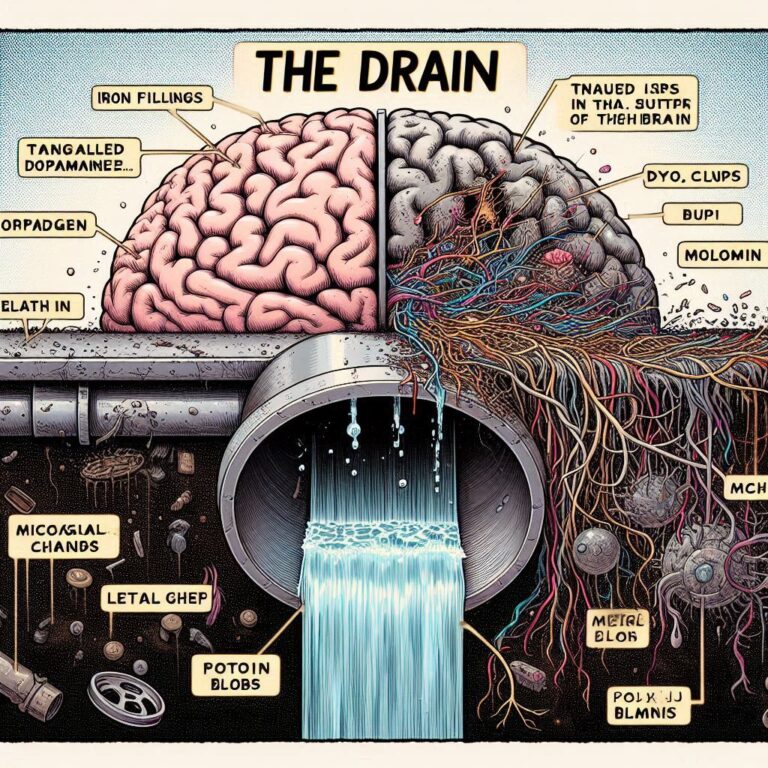
Later in life, or after prolonged upstream strain, glymphatic capacity declines. Protein and iron debris accumulate, microglia remain primed, clocks drift, and the boundary niche deteriorates further. Neurodegenerative phenotypes become more probable.
Most real patients show mixed vectors. The clinical label is the visible surface of the dominant and secondary failures.
Iron, Redox and the Same Architecture
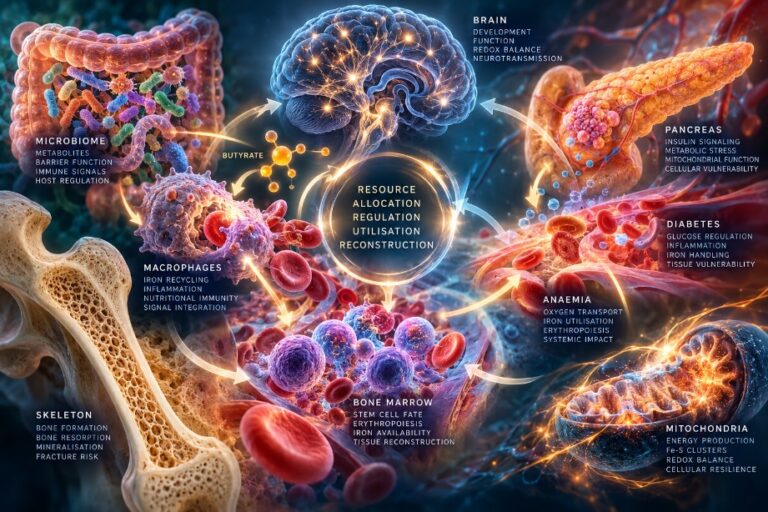
Earlier independent mining of iron handling across microbiome, stem-cell, bone, autism and diabetes literatures revealed recurring behaviours that fit inside this frame. Measured iron abundance frequently fails to equal functional utilisation. Local marrow or tissue iron can diverge from systemic markers. Macrophages reallocate iron under microbial and inflammatory signals. Membrane phosphatidylcholine status influences ferroptosis resistance. Mitochondrial and redox capacity determine whether iron is used productively or becomes damaging.
These are not separate stories. They are expressions of allocation under constraint, availability–utilisation dissociation, and incomplete clearance of oxidative and inflammatory residues — the same dimensions that appear in the TCVG loop. Iron is one of the resources whose routing is altered when the boundary signal collapses and choline is diverted.
What the Framework Does and Does Not Claim
It claims that a coherent physiological loop links microbial boundary ecology, choline-dependent identity chemistry, autonomic state-switching and sleep-dependent clearance, and that disruption of this loop at different nodes and ages produces recognisable patterns currently treated as separate diseases.
It does not claim that every case of autism, colitis or dementia is caused solely by Trio collapse, or that restoring butyrate will reverse advanced neurodegeneration. It does not replace molecular immunology, genetics or organ-specific pathology. It offers an organising structure that can integrate them.
Many of the individual mechanistic links have experimental support: butyrate and tight junctions, SCFAs and Treg induction, acetylcholine and the cholinergic anti-inflammatory pathway, norepinephrine suppression of glymphatic inflow, aquaporin-4 polarisation requirements, and the sensitivity of ferroptosis to membrane lipid composition. The full closed-loop claim, the developmental timing maps, and the assertion that labels dissolve once the loop is restored remain hypothesis-generating. They require longitudinal, multi-compartment studies that measure functional throughput rather than isolated markers.
Clinical and Research Implications
If the architecture is even partially correct, several habits become harder to defend.
Interventions that begin at the most downstream node (forcing sleep, stimulating the vagus in isolation, adding choline without restoring routing capacity) are likely to produce partial or transient effects. Sequence matters: boundary signal first, identity routing second, autonomic stabilisation third, clearance as an emergent property.
Circulating markers are necessary but insufficient. Normal ferritin does not guarantee functional iron utilisation. Normal inflammatory markers do not guarantee completed clearance. Microbial abundance does not equal metabolite output or host signalling.
Recovery is not the same as marker correction. Reconstructing network relationships — transport, allocation, timing, feedback — is required. Single-component fixes frequently fail to unlock the loop.
Research designs that stay inside one specialty will continue to miss the cross-node dynamics. Designs that simultaneously track microbial functional output, choline fate, autonomic metrics, sleep architecture and clearance proxies in the same individuals over time are the more decisive tests.
Closing
Disease persists not only because the body cannot respond, but because it cannot complete. Boundaries remain leaky, identity signals remain noisy, clearance remains unfinished. The resulting state is self-reinforcing.
The Boundary–Identity–Clearance framework and the TCVG loop are offered as a description of that architecture. They are not a finished theory and not a treatment protocol. They are an invitation to measure the system the way it actually operates — as a closed, timed, resource-allocating loop — rather than as a collection of disconnected diseases. Whether the invitation proves useful will be decided by experiments that test the nodes together, not by further subdivision of the labels.