Glyphosate and the Biological Collapse at the Amino Acid Level
Glyphosate and the Biological Collapse at the Amino Acid Level
The Chorismate Junction and the Hidden Propagation of Metabolic Constraint
Most biological research still proceeds inside silos. A neuroscientist studying serotonin rarely tracks the same molecule’s fate through the kynurenine pathway and the aryl hydrocarbon receptor. A vascular biologist focused on nitric oxide seldom measures tetrahydrobiopterin regeneration in parallel with folate status. A microbiologist examining gut indole production may not connect those metabolites to host monoamine synthesis or mitochondrial iron–sulphur cluster assembly. Different fields often use different names for overlapping chemistry and start their maps at different points, so the same constrained network can remain invisible even when its pieces are well known inside each specialty.
This article reconstructs one continuous chain that begins with an agricultural intervention and ends in a set of shared host bottlenecks. The chain is not speculative. The enzymes, cofactors and stoichiometric relationships have been mapped for decades. What has been under-emphasised is how tightly they are coupled and how an upstream reduction in a single plant metabolic branch point can propagate constraint through multiple high-value physiological systems at once.
Chorismate Is Foundational Biology, Not a Minor Side Path
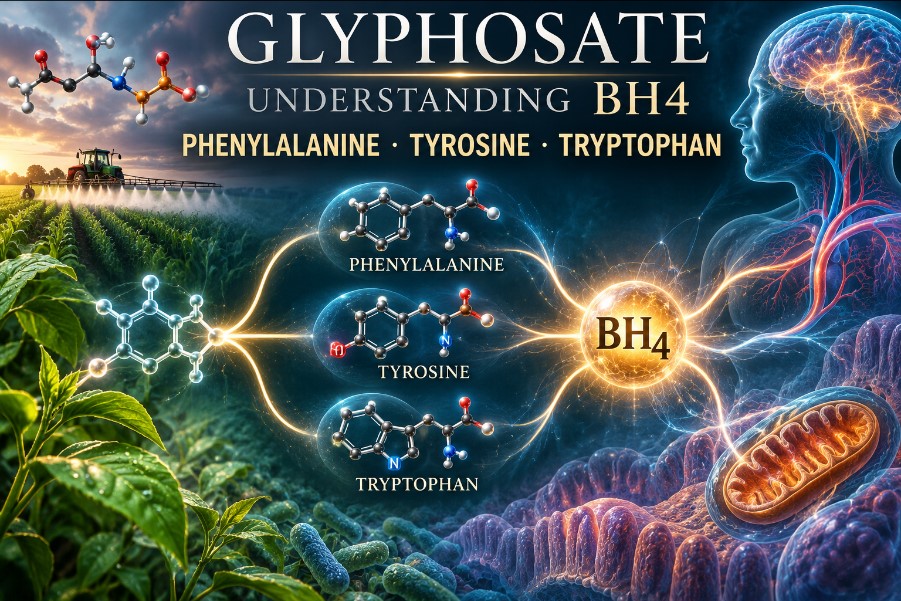
Chorismate is the last common precursor produced by the shikimate pathway in plants, bacteria, fungi and archaea. Animals do not make it. From chorismate the pathway splits into the three aromatic amino acids—phenylalanine, tyrosine and tryptophan—and into a range of other essential products including folate precursors, quinones and a large family of secondary metabolites (phenylpropanoids, certain alkaloids, phytoalexins and signalling molecules).
This is base metabolic architecture. In plants it supplies the aromatic amino acids required for protein synthesis and the secondary compounds that shape defence, structure and ecological interactions. In many microbes it is equally central. When chorismate supply falls, the effects are not confined to one downstream metabolite; they reduce the entire branch of chemistry that depends on it. That is why inhibition of the enzyme that produces chorismate (EPSPS) is such an effective herbicide: it starves the plant of multiple essential outputs simultaneously.
The three aromatic amino acids that leave this junction become, in animals, the starting points for catecholamines, serotonin, melatonin, the kynurenine pathway (including de-novo NAD+ synthesis), and a variety of microbial transformation products that act as signals. Chorismate is therefore not a peripheral plant pathway. It is an upstream branch point whose products feed a large fraction of host neurotransmission, vascular signalling, immune regulation and redox metabolism.
What Glyphosate Does at the Origin
Glyphosate inhibits EPSPS by occupying the phosphoenolpyruvate-binding site. The immediate results in sensitive plants are accumulation of shikimate intermediates and depletion of chorismate. Phenylalanine, tyrosine and tryptophan levels decline. Secondary-metabolite diversity falls. Protein amino-acid profiles shift even when total nitrogen content looks adequate.
Because a large share of the modern plant-derived food supply is produced under glyphosate pressure (tolerant crops or pre-harvest desiccation), the biochemical composition of the primary producer is altered before the material enters any animal or human digestive tract. Residual glyphosate can also reach the gut lumen. Although most abundant human gut taxa appear to be aromatic-amino-acid auxotrophs under ordinary conditions, a subset encodes glyphosate-sensitive EPSPS enzymes. Exposure can therefore exert selective pressure on microbial community composition and on the metabolic functions those communities perform.
The dual upstream effect is a reduction in the quality and quantity of chorismate-derived inputs arriving from the diet, plus potential disruption of the microbial guilds that normally transform those inputs or generate complementary signals (indoles, secondary bile acids, short-chain fatty acids, polyamines).
Entry into Host Metabolism
Once absorbed, the three aromatic amino acids feed pathways that textbooks still present largely in isolation.
Phenylalanine is converted to tyrosine by phenylalanine hydroxylase. Tyrosine is converted to L-DOPA by tyrosine hydroxylase, the rate-limiting step of dopamine, norepinephrine and epinephrine synthesis. Tryptophan is converted to 5-hydroxytryptophan by tryptophan hydroxylase (TPH1 in the gut and periphery, TPH2 in the brain), the rate-limiting step of serotonin synthesis; serotonin is further converted to melatonin. The same tryptophan molecule is also the substrate for the quantitatively dominant kynurenine pathway, initiated by IDO or TDO, which produces kynurenine, kynurenic acid, quinolinic acid and ultimately NAD+. Microbial enzymes can transform residual tryptophan into indoles that act as ligands for the aryl hydrocarbon receptor.
All three aromatic-amino-acid hydroxylases and all three nitric-oxide synthase isoforms require the same cofactor: tetrahydrobiopterin (BH4), together with ferrous iron and oxygen. This single shared requirement is the first major convergence point.
The BH4 Network: A Central Regenerative Bottleneck
BH4 is synthesised de novo from GTP. The first and rate-limiting enzyme, GTP cyclohydrolase I, is inducible by cytokines. After BH4 is used by the hydroxylases it can be recycled by a dedicated pathway. It can also be regenerated from its oxidised form (BH2) by dihydrofolate reductase—the same enzyme that reduces dihydrofolate in the folate cycle. Folate status and BH4 regeneration are therefore stoichiometrically linked.
Oxidative stress converts BH4 to BH2. When the BH2:BH4 ratio rises, nitric-oxide synthase uncouples: it produces superoxide instead of nitric oxide. The extra superoxide oxidises more BH4, creating a self-amplifying loop. The same reduction in BH4 availability simultaneously limits dopamine synthesis, serotonin synthesis and coupled nitric-oxide production.
This is why BH4 status functions as a systems-level constraint. It is sensitive to aromatic-amino-acid supply, inflammatory tone, cellular redox balance and one-carbon status at the same time. No other small molecule sits at this exact intersection of monoamine neurotransmission and nitric-oxide signalling while remaining so tightly coupled to folate and redox metabolism.
Additional Shared Dependencies
Several other processes amplify the constraint.
Mitochondrial iron–sulphur cluster assembly uses sulfur abstracted from cysteine and supplies clusters required for the electron-transport chain, aconitase and ferrochelatase (the final enzyme of heme synthesis). Heme itself is a prosthetic group of the nitric-oxide synthases and of sulfite oxidase. Impairment of Fe-S or heme biogenesis therefore hits energy production, iron homeostasis and heme-dependent enzymes together.
Sulfite oxidase, a molybdenum-dependent mitochondrial enzyme, converts sulfite (generated during cysteine and methionine breakdown) into sulfate. Failure of this step allows toxic sulfite to accumulate. Cysteine is also the sulfur donor for Fe-S clusters and a precursor for glutathione, so sulfur-amino-acid status feeds antioxidant capacity, respiratory-chain assembly and sulfite load simultaneously.
NADPH, generated largely by the oxidative pentose-phosphate pathway, is required for glutathione reductase, for BH4-related redox chemistry and for nitric-oxide synthase. Glutathione itself depends on cysteine availability. Arginine is competed for by nitric-oxide synthases and by the polyamine pathway. Selenium is required for deiodinases and glutathione peroxidases.
These are not exotic side reactions. They are core stoichiometric relationships.
How Constraint Propagates and Becomes Self-Sustaining
When chorismate-derived inputs are reduced and the shared regenerative systems are stressed, the network does not simply scale down proportionally. It reconfigures.
Inflammation induces IDO, diverting tryptophan into the kynurenine pathway and away from serotonin. The same inflammatory milieu raises oxidative pressure that consumes BH4 and favours nitric-oxide synthase uncoupling. Reduced secondary-bile-acid production (dependent on microbial 7α-dehydroxylation) removes a normal stimulus for colonic serotonin synthesis. Declining mitochondrial capacity increases baseline oxidant generation, further taxing BH4 and glutathione. The aryl hydrocarbon receptor, which senses both host kynurenine metabolites and microbial indoles, receives a shifted ligand profile and alters barrier and immune set-points accordingly.
Each of these changes reinforces the others. The restricted configuration—lower serotonin and catecholamine tone, reduced coupled nitric oxide, elevated oxidant load, altered AhR signalling, constrained one-carbon and redox capacity—can persist because the regenerative resources required to reopen the alternative routes have themselves been compromised. Correction cost rises; metabolic flexibility falls.
This pattern is visible in the recurring metabolomic and clinical signatures that appear across neurological, gastrointestinal, cardiovascular and chronic-inflammatory cohorts: elevated kynurenine-to-tryptophan ratios, evidence of BH4 oxidation or nitric-oxide synthase uncoupling, reduced secondary-bile-acid diversity, and markers of strained glutathione and one-carbon metabolism. The signatures overlap even when the diagnostic labels differ.
Why This Has Remained Lesser Known
The plant-level effects of glyphosate on the shikimate pathway are well documented. Microbial shifts after exposure have been reported. Individual host pathways (serotonin, nitric oxide, kynurenine, glutathione) are intensively studied. What has been missing is the continuous tracing of how an upstream reduction in chorismate flux, compounded by microbial and host regenerative constraints, can propagate through the shared nodes and stabilise a lower-flexibility regime.
Silos obscure the coupling. Different fields name the same molecules differently or begin their maps at different points. BH4 appears in the nitric-oxide literature, the monoamine literature and the rare-disease literature, but is rarely treated as a systems-level regenerative bottleneck whose status is jointly determined by substrate supply, inflammation, redox state and folate metabolism. Iron–sulphur cluster assembly is core mitochondrial biology, yet its dependence on cysteine and its consequences for heme-dependent enzymes are seldom placed next to monoamine and nitric-oxide chemistry in the same diagram. The aryl hydrocarbon receptor is studied by immunologists and barrier biologists, but its position downstream of tryptophan partitioning between host and microbes is not always linked back to serotonin availability.
The result is that the network remains fragmented even though every individual edge is established biochemistry.
What the Reconstruction Shows
The reconstruction does not claim that glyphosate is the sole or primary cause of any specific chronic disease. It shows that an upstream agricultural intervention capable of reducing chorismate-derived outputs can, through well-characterised enzymatic and stoichiometric relationships, constrain a set of shared host regenerative systems. Those systems gate monoamine synthesis, nitric-oxide signalling, redox buffering, energy metabolism and aspects of immune and barrier regulation. When the constraints close into reinforcing loops, a restricted metabolic configuration can emerge and persist.
The highest-leverage nodes inside that configuration are the BH4 regenerative network (including its link to folate via dihydrofolate reductase), mitochondrial iron–sulphur cluster and heme assembly, sulfite detoxification capacity, and the balance of aryl-hydrocarbon-receptor ligands generated by host and microbial tryptophan metabolism.
Practical Consequences for Measurement and Experiment
Single-pathway studies will continue to leave large fractions of variance unexplained. Priority measurements are simultaneous: aromatic amino acids, BH4 and BH2, folate intermediates, kynurenine-pathway and microbial indole metabolites, secondary bile acids, glutathione redox state, markers of Fe-S cluster integrity, and sulfite/sulfate ratios. These should be collected under controlled variation of diet, microbial composition and inflammatory tone.
Interventions that address only one node at a time are likely to produce partial or transient effects. Designs that support multiple shared nodes concurrently—aromatic-amino-acid availability, BH4 and redox capacity, one-carbon status, and microbial functional guilds—offer a clearer test of whether the restricted configuration can be reopened.
Upstream, food-composition and agricultural research that reports the full profile of free and protein-bound aromatic amino acids, secondary metabolites and residual herbicide under realistic use conditions would close the origin-side data gap.
Closing
Chorismate is a foundational branch point. Its products feed a large fraction of the chemistry that animals use for neurotransmission, vascular signalling, immune regulation and cellular redox control. The enzymes and cofactors that process those products are tightly shared. When supply from the origin is reduced and the shared regenerative systems are stressed, the network can shift into a lower-flexibility state that reinforces itself.
The individual pieces of this map have been known for a long time. The continuous, systems-level connection from agricultural chorismate inhibition through microbial ecology to host monoamine, nitric-oxide, redox and mitochondrial constraints has been far less visible—precisely because the relevant expertise is distributed across silos that rarely examine the same molecules at the same time.
Making that connection explicit does not simplify the biology. It makes the real complexity visible and, therefore, measurable.