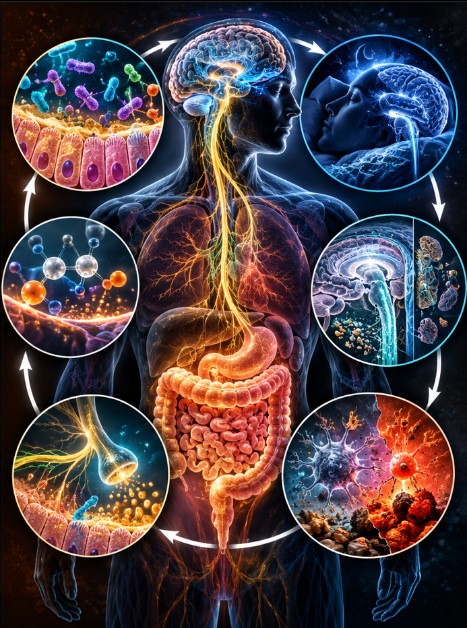
The Hidden Architecture of Biological Dysfunction
The Hidden Architecture of Biological Dysfunction
The Hidden Architecture of Biological Dysfunction
Iron, the Microbiome, Diabetes, Anaemia and the Skeleton: Searching for a Common Regulatory Language
An independent research reflection on Secondary Biological State, regulatory persistence and the recurring behaviours that connect seemingly separate biological systems.
Research record: 23 October 2026
Research programme: SBS · Regulatory Lock · CTR · ADAM
1. What happens when we stop organising biology by disease?
Modern medicine has made extraordinary progress by dividing biology into specialised fields. Iron metabolism, diabetes, anaemia, skeletal degeneration, neurodevelopment and the gut microbiome each have their own literature, terminology and clinical measurements.
That specialisation is necessary. Each field contains complex mechanisms that demand detailed study.
But there is another question worth asking.
What if we also organised our observations according to how biological systems behave when they are disturbed?
Across research into iron regulation, mitochondrial function, inflammation, microbial ecology, blood formation and skeletal health, a recurring set of behaviours emerges. A resource may be present but poorly utilised. Its allocation may change under stress. A protective response may become persistent. The components of a system may remain present while its functional throughput declines. Correcting an individual measurement may not restore coordinated function.
These are not identical mechanisms. They are recurring patterns of regulation that can be investigated across different mechanisms.
This distinction became increasingly important during our investigations into iron handling, redox regulation, glutathione, mitochondrial function, ATP, NAD, choline, vitamin B1 transport, microbial metabolites and tissue reconstruction.
The individual investigations repeatedly raised a similar question:
Are we looking at isolated abnormalities, or are we observing different expressions of recurring problems in how biological systems regulate, allocate, utilise and restore their resources?
That question is the starting point for this research reflection.
2. Iron: the difference between having a resource and using it
Iron is an ideal place to begin because its biology exposes a fundamental problem with interpreting measurements in isolation.
Iron is required for mitochondrial respiration, haem synthesis, iron–sulfur clusters, DNA synthesis and numerous other cellular functions. The body therefore has elaborate systems for absorbing, transporting, storing, releasing and recycling it.
These processes are tightly regulated because iron is both essential and potentially damaging. Excess labile iron can promote oxidative injury, while inadequate delivery can impair essential cellular functions. A major review of cellular and systemic iron homeostasis describes the regulatory networks controlling iron trafficking, storage mobilisation, mitochondrial use and systemic distribution. https://doi.org/10.1038/s41580-023-00648-1
The important distinction is that iron concentration and iron utilisation are not interchangeable.
Ferritin, serum iron, transferrin saturation and haemoglobin each provide useful information. None independently describes every stage of iron handling within every tissue.
A circulating measurement cannot, by itself, establish whether iron is being released appropriately from storage, delivered to a particular cell, incorporated into haem or iron–sulfur clusters, or used effectively by mitochondria.
This is not an argument against conventional iron tests. It is an argument for interpreting them within the functional process they are intended to help us understand.
The question shifts from simply asking how much iron is present to asking how effectively the iron-regulatory system is operating.
That distinction becomes especially interesting when we compare different tissues and biological conditions.
3. The cross-system overlay
Diabetes, anaemia and skeletal dysfunction are not interchangeable conditions. Their definitions, diagnostic criteria and immediate mechanisms differ.
Yet iron handling, inflammation, redox balance, mitochondrial function and tissue renewal can intersect within all three.
The table below maps that overlap. It separates established physiological relationships from the broader regulatory interpretation we are investigating.
Table 1. Where the regulatory behaviours intersect
| Biological domain | Important regulatory problem | Functional consequences to investigate | Relevant measurements |
|---|---|---|---|
| Iron regulation | Transport, storage, release, recycling and tissue allocation may become uncoupled | Local iron restriction, inappropriate accumulation, impaired cellular use | Ferritin, serum iron, transferrin saturation, hepcidin, ferroportin, tissue or cellular iron measures |
| Anaemia | Reduced haemoglobin or red-cell production can arise through different mechanisms, including iron deficiency, inflammation and impaired erythropoiesis | Reduced oxygen-carrying capacity, altered iron distribution and reduced physiological reserve | CBC, haemoglobin, red-cell indices, reticulocytes, iron studies and cause-specific investigations |
| Diabetes | Glucose regulation, insulin signalling, inflammation and cellular metabolism interact | Altered iron handling in some metabolic contexts, oxidative stress and tissue-specific vulnerability | Glucose, HbA1c, insulin-related measures where appropriate, iron-regulatory markers and tissue-specific functional measures |
| Skeletal health | Bone formation, resorption, mineralisation and repair must remain coordinated | Reduced bone quality, altered remodelling, fragility or impaired repair | Fracture history, bone density, bone architecture, mineral metabolism and relevant turnover markers |
| Mitochondrial and redox systems | Substrate delivery, respiratory function and antioxidant capacity must meet demand | Reduced energy throughput, oxidative injury or increased vulnerability to lipid peroxidation | Functional metabolic assays, relevant redox measures, mitochondrial assays and context-specific iron measurements |
| Microbial ecology | Organism abundance, metabolic output and host signalling may diverge | Altered short-chain fatty acid production, cross-feeding and host-response regulation | Microbial composition alongside metabolite profiles and functional or host-response measures |
| Bone marrow and tissue renewal | Resource availability and local signalling influence cellular maintenance and differentiation | Altered blood-cell production, stem-cell fate and tissue reconstruction | Local niche measurements in research settings, macrophage function, cellular iron handling and lineage outcomes |
The point of this comparison is not that every person with diabetes, anaemia or skeletal disease has the same underlying defect.
It is that these domains contain regulatory processes that can be compared directly, even when their clinical expressions differ.
The distinction is especially important in diabetes. Skeletal fragility is recognised in both type 1 and type 2 diabetes, and fracture risk is not always adequately captured by conventional bone-mineral-density measurements. The relationships are complex and heterogeneous rather than reducible to a single mechanism. https://doi.org/10.1007/s00125-024-06172-x
Likewise, iron deficiency, inflammatory iron restriction and iron excess can affect bone through different pathways. A 2024 review describes how iron overload can promote osteoclast activity and inhibit osteoblasts, while anaemia can alter bone turnover and, in some circumstances, contribute to disturbances in phosphate regulation and mineralisation. https://pubmed.ncbi.nlm.nih.gov/38957399/
The common thread is not simply the presence of iron abnormalities. It is the relationship between resource handling, cellular function and the demands of the tissue.
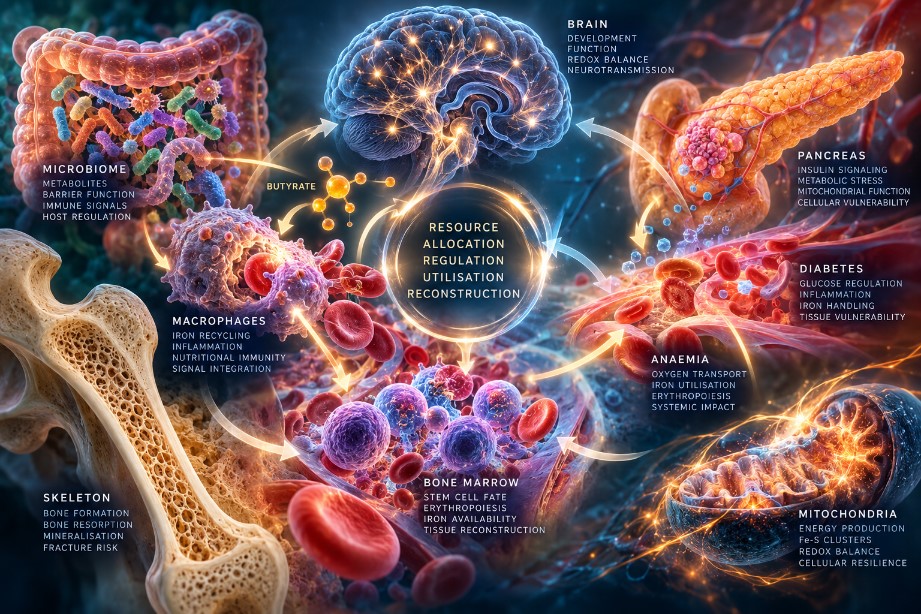
4. The microbiome–iron–bone-marrow connection
One of the clearest experimental examples of these relationships comes from research published in Cell Stem Cell in 2022.
Zhang and colleagues investigated how the gut microbiota influences haematopoietic stem-cell behaviour under regenerative stress. In mice, microbiota depletion impaired red-blood-cell recycling by bone-marrow macrophages. Local bone-marrow iron availability declined, even though systemic iron homeostasis was largely unchanged.
The altered local environment affected stem-cell decisions: self-renewal increased while differentiation was compromised. The researchers also found that microbiota-derived butyrate could improve macrophage erythrophagocytosis and restore important aspects of local iron availability and haematopoietic regeneration.
The paper is available here: https://doi.org/10.1016/j.stem.2021.12.009
This finding is valuable because it connects multiple levels of physiology in one experimentally investigated pathway.
Gut microbial activity → butyrate signalling → macrophage function → local iron recycling → stem-cell behaviour → blood-cell regeneration.
It also reveals why a systemic measurement may fail to capture a local functional problem.
The iron was not simply disappearing from the organism. Its local availability was changing because the recycling process that supported the marrow environment had been disrupted.
That is a concrete example of a regulatory relationship between microbial ecology and host resource allocation.
It does not establish that this exact pathway operates identically in human diabetes, osteoporosis or neurodevelopmental conditions. It does establish that a microbial signal can influence host iron handling and tissue reconstruction in an experimental model.
That is already a significant physiological connection.
Table 2. Three biological systems, one useful comparison
| System | Observed or established mechanism | Regulatory question |
|---|---|---|
| Bone marrow under stress | Microbiota-derived butyrate influences macrophage red-cell recycling, local iron availability and stem-cell differentiation in mice | Can local resource allocation change despite relatively stable systemic measurements? |
| Diabetes and skeletal health | Diabetes is associated with skeletal fragility through multiple interacting metabolic, cellular and architectural factors; iron dysregulation and ferroptosis are additional mechanisms under investigation | How do metabolic stress, iron handling and redox balance influence bone formation, resorption and repair? |
| Anaemia and iron regulation | Iron deficiency, inflammation, impaired erythropoiesis and other mechanisms can produce anaemia; inflammatory signalling can restrict iron availability | Is the limiting factor inadequate total iron, impaired delivery, impaired utilisation or another cause of reduced red-cell production? |
These are not three demonstrations of one identical process. They are three settings in which resource availability, regulation and physiological output must be distinguished.
The value of the comparison is that it gives us a shared set of questions to take back into each field.
5. Six recurring regulatory behaviours
The cross-literature investigation identified six behaviours that deserve to be examined systematically.
Availability versus utilisation
A resource can be present without being effectively used.
This may arise through restricted transport, altered compartmentalisation, defective conversion, inappropriate storage or impaired incorporation into functional molecules.
For iron, the relevant question is whether it reaches the cellular processes that require it. For the microbiome, it is whether the community produces the metabolites and signals needed for the functions being studied.
Allocation versus demand
Resources can be redirected according to changing biological priorities.
Inflammatory iron sequestration is one example: a protective response can reduce iron availability for erythropoiesis. In the bone-marrow model, altered macrophage recycling changed the local iron environment and influenced stem-cell decisions.
The broader question is whether a system is experiencing absolute resource scarcity, inappropriate allocation, increased demand, or some combination of the three.
Correction versus persistence
A disturbance may continue because the regulatory relationships that maintain it remain active.
Inflammatory signalling can influence iron handling. Mitochondrial damage can reinforce oxidative pressure. Microbial changes can alter metabolite output and thereby affect host physiology.
These mechanisms are not all equivalent, and their capacity to maintain a new state differs. But they provide concrete starting points for investigating persistence.
Throughput versus bottleneck
The required components may exist while the complete process fails to meet demand.
Transport, recycling, conversion, energy production or coordination between stages may become limiting.
The resulting problem may not be solved by simply adding more of the resource that enters the pathway. The limiting step must first be identified.
Correction versus reconstruction
Normalising one measurement does not guarantee restoration of the relationships that produced normal function.
A restored circulating value, microbial taxon or inflammatory marker may represent genuine improvement without establishing that the entire system has recovered.
The question is whether the system has regained coordinated function, not merely whether one component has changed.
Local versus systemic expression
Different tissues can respond differently to overlapping regulatory disturbances.
Their energy requirements, developmental timing, cellular architecture and compensatory capacity differ. A mechanism that alters stem-cell differentiation in marrow need not produce the same outcome in a pancreatic beta cell or a developing neural cell.
This is how a common regulatory question can remain useful without requiring a single disease mechanism.
6. What changes when we introduce SBS?
The recurring behaviours described above led us to a broader question: can several connected abnormalities represent a changed biological configuration rather than a collection of independent defects?
This is the question behind Secondary Biological State (SBS).
SBS is our proposed framework for describing an altered configuration of biological functioning that emerges following disturbance. It allows us to investigate the possibility that changes in resource allocation, signalling, metabolism, microbial ecology and tissue repair can interact to produce a wider state.
The related concept of Regulatory Lock addresses persistence: how a changed configuration may be maintained by feedback, compensation or altered regulatory thresholds after the initiating disturbance has diminished.
The distinction matters.
SBS describes the configuration. Regulatory Lock asks why it persists.
Neither term is intended to replace established mechanisms or clinical diagnoses. The purpose is to give us a way to organise observations that might otherwise remain scattered across different areas of physiology.
This is also why the microbiome–iron–bone-marrow example is so useful. It shows how changes at one biological level can influence processes at another, through a sequence of measurable mechanisms.
The larger SBS question is whether similar patterns of interacting constraints can be identified across other systems, and whether the framework can help predict which functions are likely to become impaired or which measurements would best distinguish competing explanations.
7. CTR: the cost of correction and the capacity to rebuild
The Correction Cost–Throughput–Replication lens offers a further way to examine the same problem.
- C — Correction Cost: the unresolved burden the system must manage, including ongoing damage, inflammation or metabolic pressure.
- T — Throughput: the capacity to transport, process, recycle and utilise resources at the rate required.
- R — Replication and reconstruction: the capacity to restore cells, tissue architecture, differentiation and coordinated function.
Consider a system with sustained inflammatory pressure, restricted iron delivery and impaired tissue renewal.
The question is not simply whether iron is low or high. It is how much unresolved burden remains, which steps limit functional throughput and whether the system can reconstruct the functions that have been compromised.
The same questions can be asked of a microbial ecosystem. Is the relevant metabolic output being produced? Are host signalling relationships intact? Does recovery of an individual organism restore the functional network, or does the wider ecosystem remain altered?
CTR is a proposed analytical lens, not an established clinical scoring system. Its usefulness will depend on whether the dimensions can be operationalised with measurable variables and whether they help distinguish different routes to dysfunction and recovery.
8. A common physiological language
The research is beginning to suggest a useful distinction between what a system contains and what a system can do.
That distinction can be applied across biological domains without assuming their mechanisms are identical.
| Regulatory dimension | Question to investigate | Example of a relevant measurement strategy |
|---|---|---|
| Availability | Is the resource present in the relevant compartment? | Compare systemic and local measures where feasible |
| Utilisation | Is the resource reaching its functional destination? | Measure downstream functional output or pathway activity |
| Allocation | Where is the resource going, and what demands determine its distribution? | Examine transport, storage, recycling and tissue-specific handling |
| Throughput | Can the process sustain the required rate? | Measure flux, turnover or functional capacity rather than abundance alone |
| Persistence | Does the altered behaviour remain when the original stress is reduced? | Use longitudinal or intervention-based designs |
| Reconstruction | Does correction restore coordinated function? | Measure recovery across several linked components and physiological outputs |
| Flexibility | Can the system adapt appropriately to changing demand? | Examine responses to defined challenges or changes in demand |
This is the beginning of a shared language for asking physiological questions across different research fields.
Its value would be practical. It could help researchers identify when two apparently unrelated findings deserve comparison, determine which measurements are missing, and distinguish a shared regulatory behaviour from a superficial resemblance.
It could also help structure diagnostic research by making the reasoning between observations and interpretations more explicit.
That is part of the motivation behind ADAM, our developing diagnostic operating-system concept: to organise biological inputs into a coherent account of system state, interacting processes, possible persistence mechanisms and the measurements most likely to resolve uncertainty.
9. The research direction from here
The next step is to test whether these regulatory dimensions can be applied consistently across independent biological systems.
That means looking for evidence that distinguishes:
- A resource shortage from a utilisation problem.
- A local allocation failure from a systemic deficiency.
- A transient response from a persistent altered configuration.
- A bottleneck from a general loss of capacity.
- Correction of a component from reconstruction of the wider system.
The microbiome–iron–bone-marrow pathway offers a particularly clear experimental starting point. Diabetes, skeletal dysfunction and anaemia offer additional settings in which resource handling, inflammation, cellular function and tissue-specific outcomes can be examined.
The aim is not to force every finding into SBS or to declare that every condition has one cause. It is to establish whether the framework helps us describe the observations, formulate better questions and generate predictions that can be evaluated against new evidence.
The strongest research frameworks do more than explain findings after the fact. They help identify what should be measured next, where competing explanations differ and what result would change the interpretation.
That is the standard this work should pursue.
Closing thought: biological systems do not merely break
They adapt. They allocate. They compensate. They sometimes fail to restore what has been lost.
Across the literature, we can already find examples in which resource abundance diverges from functional use, local conditions diverge from systemic measurements, protective mechanisms alter subsequent physiology, and correcting one component does not automatically reconstruct the wider system.
These observations provide a substantial foundation for further investigation.
The emerging question is whether they can be brought together through a common language of regulation, throughput, persistence and reconstruction—and whether that language can help explain why different biological systems sometimes arrive at related functional problems through different mechanisms.
That is the direction in which our work on SBS, Regulatory Lock, CTR and ADAM continues to develop.
Not towards the claim that every disease is the same, but towards a more integrated way of investigating how biological systems change state, maintain that state and recover their capacity to function.
Research provenance
Record date: 23 October 2026
Research stage: Exploratory cross-system synthesis
Research programme: Secondary Biological State (SBS), Regulatory Lock, Correction Cost–Throughput–Replication (CTR), and ADAM.
This entry documents the development of a research question arising from iterative investigations into iron regulation, microbial ecology, inflammation, redox physiology, metabolic function and tissue reconstruction. It records the proposed use of shared regulatory dimensions to compare biological systems traditionally studied in separate research domains.
SBS, Regulatory Lock and CTR are developing conceptual frameworks. The synthesis presented here combines published findings with an explicitly interpretive research programme. The concepts and hypotheses remain open to refinement as further evidence is examined.
Selected references
- Zhang D, et al. The microbiota regulates hematopoietic stem cell fate decisions by controlling iron availability in bone marrow. Cell Stem Cell. 2022;29(2):232–247.e7. https://doi.org/10.1016/j.stem.2021.12.009
- Galy B, Conrad M, Muckenthaler MU. Mechanisms controlling cellular and systemic iron homeostasis. Nature Reviews Molecular Cell Biology. 2024;25:133–155. https://doi.org/10.1038/s41580-023-00648-1
- Bone metabolism in diabetes: a clinician’s guide to understanding the bone–glucose interplay. Diabetologia. https://doi.org/10.1007/s00125-024-06172-x
- Bone Health in Patients With Type 2 Diabetes. Journal of the Endocrine Society. 2024;8(7). https://doi.org/10.1210/jendso/bvae112
- Iron and bones: effects of iron overload, deficiency and anemia treatments on bone. 2024. https://pubmed.ncbi.nlm.nih.gov/38957399/